

A garage conversion is defined as the process of transforming a non-habitable garage space into a functional, legally compliant living area. For many homeowners, it is one of the most cost-effective ways to add usable square footage without extending the footprint of the property. The question of what rooms can a garage become has a genuinely wide answer: from a home office or guest bedroom to a gym, playroom, or hobby studio. Getting the room type right depends on your household’s needs, your budget, and how well the new space integrates with the rest of your home. This guide covers the most popular garage conversion ideas, the legal requirements you must meet, and realistic costs for 2026.
!
What rooms can a garage become? Popular options for 2026
The most popular conversion rooms include home offices, guest bedrooms with en-suites, home gyms, playrooms, and hobby or art studios. That list reflects a broader shift in how UK homeowners use their homes. Since hybrid working became the norm, demand for dedicated home office space has grown considerably. A single garage offers enough floor area for a comfortable desk setup, storage, and even a small meeting area.

Guest bedrooms are another top choice, particularly when families want to accommodate relatives without sacrificing a main bedroom. Adding an en-suite to a garage bedroom creates a self-contained guest suite that feels genuinely welcoming. A home gym is one of the most straightforward conversions in terms of building regulations, since it does not require plumbing and has fewer compliance hurdles than a bedroom.
Less common but increasingly popular options include:
- Home theatre or cinema room: The garage’s solid walls provide natural sound insulation, making it well suited to acoustic treatment.
- Meditation or yoga studio: A quiet, separate space away from the main household is highly valued by homeowners who prioritise wellbeing.
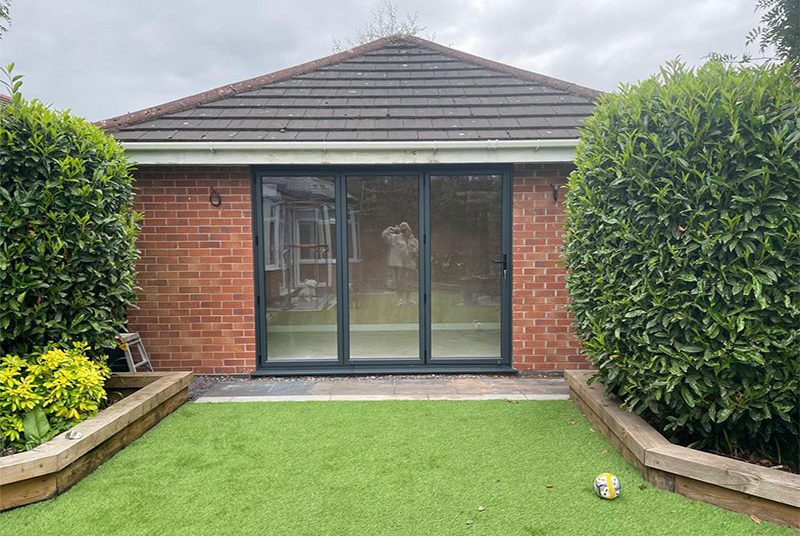
- Sunroom or garden room: Replacing the garage door with bi-folding doors and adding roof lights creates a light-filled space that connects to the garden.
- Hobby or art studio: Excellent for messy creative work that benefits from separation from living areas.
- Teenage den or games room: Gives older children their own space while keeping noise away from the main house.
- Annexe or guest suite with kitchenette: A double garage can accommodate a small self-contained unit, which may generate rental income.
A single garage typically offers around 15–20 square metres of floor space. That is sufficient for a bedroom, office, or gym. A double garage opens up more ambitious options, including a full annexe with a bathroom and kitchenette. Partial conversions of a double garage, where one bay becomes a room and the other remains as storage or parking, are a practical compromise that many homeowners favour in areas where off-street parking holds value.
!
What design and legal steps must you take before converting?
Turning a garage into a room is not simply a matter of painting the walls and laying a carpet. UK building regulations apply to any conversion that creates habitable space, and skipping the permitting process affects resale value and insurance. The key legal and design steps are:
- Apply for building regulations approval. Any garage conversion to habitable space requires a building regulations application, even if planning permission is not needed. Your local authority building control team or an approved inspector will oversee the work.
- Meet insulation standards. Proper insulation is mandatory for all legally habitable conversions. Walls, floors, and ceilings must achieve specified thermal performance values. Skipping this step causes failed inspections and can make the space legally unlettable.
- Install egress windows for bedrooms. If the converted space will be used as a bedroom, egress window requirements apply. Windows must meet minimum openable dimensions and be positioned to allow safe escape in an emergency. This often involves cutting through masonry, which adds to the structural scope of the project.
- Address the floor level difference. Garage floors typically sit lower than the main house floor. Raising the subfloor to match the internal level is often necessary for comfort and compliance. This reduces ceiling height slightly and adds cost, so it must be factored into the design from the outset.
- Replace or remove the garage door. Keeping the garage door behind new framing is a common mistake. The correct approach is to remove the door entirely and replace the opening with a properly insulated wall, windows, or patio doors. This step is what truly transforms the space into a room rather than a dressed-up garage.
- Upgrade ventilation, heating, and electrics. Building regulations require adequate ventilation and heating in all habitable rooms. Electrical circuits must be brought up to current standards and signed off by a Part P registered electrician.
Pro Tip: Contact your local authority building control team before any work begins. A pre-application conversation costs nothing and can save you from expensive design changes later.
Permitted development rights cover most straightforward garage conversions in England, meaning planning permission is not usually required. However, if your property is in a conservation area, is a listed building, or has had its permitted development rights removed, you will need to check with your local planning authority first.
How do costs and complexity vary by room type?
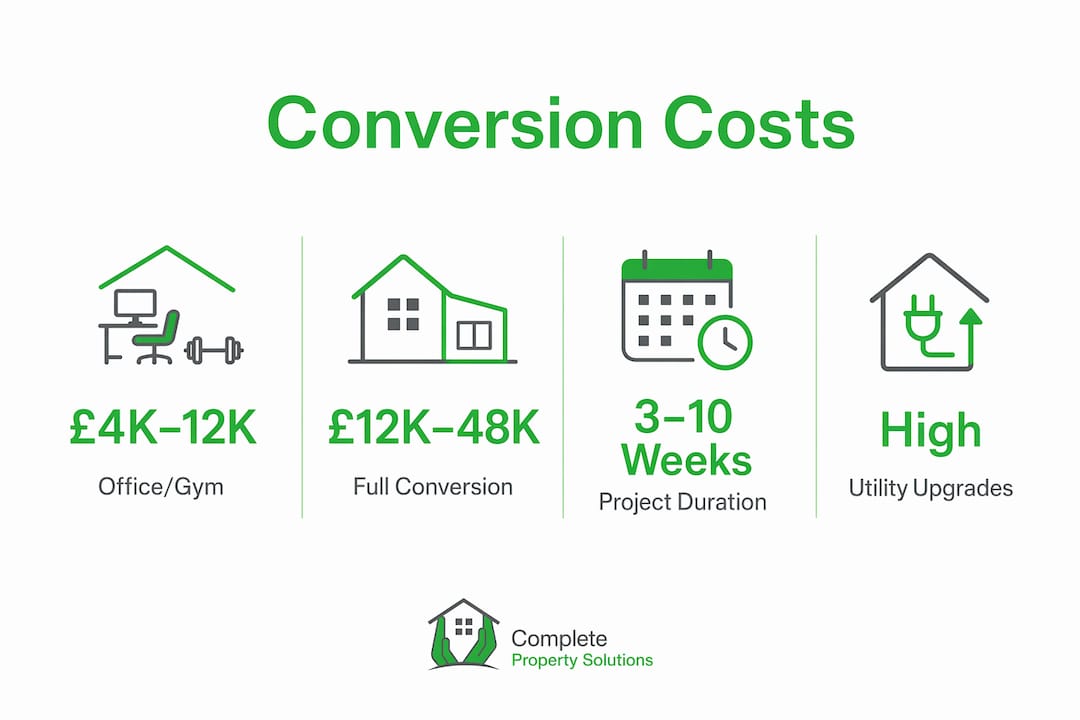
Professional garage conversions typically cost between £12,000 and £48,000 depending on utility integration and scope. Basic conversions such as gyms or offices start as low as £4,000 to £6,500. The room type you choose is the single biggest driver of cost, because it determines how much utility work is required.
| Room type | Typical cost range | Key cost drivers |
|---|---|---|
| Home office or gym | £4,000–£12,000 | Insulation, electrics, flooring, windows |
| Playroom or hobby studio | £6,000–£15,000 | Insulation, lighting, ventilation, décor |
| Guest bedroom | £10,000–£20,000 | Egress windows, insulation, heating, décor |
| Bedroom with en-suite | £15,000–£30,000 | Plumbing, tiling, sanitary ware, egress windows |
| Full annexe with kitchenette | £25,000–£48,000 | Plumbing, kitchen fitting, separate utilities |
Utility upgrades for heating, ventilation, plumbing, and electrical systems are frequently underestimated. Climate control alone can cost £2,300–£6,150. Electrical and plumbing work add further to the budget depending on how far the new room sits from existing supply routes.
Project timelines typically run 3–10 weeks for a standard conversion. A basic office or gym sits at the shorter end. A full annexe with plumbing and a kitchenette sits at the longer end, particularly if structural changes are needed for egress windows or floor raising. You can find detailed concrete slab pricing useful when budgeting for floor-level work on a double garage.
Pro Tip: Get a fixed-price quote before work starts. Cost overruns on garage conversions most often come from utility upgrades and floor-level changes that were not scoped properly at the outset.
A well-executed conversion adds genuine value to a property. Homes with additional habitable rooms consistently attract stronger buyer interest, particularly in areas where extending outward is not possible. A self-contained annexe or guest suite can also generate rental income, which improves the financial case for a higher-specification conversion.
!
How do you make a converted garage feel like part of the home?
A converted garage that feels like an afterthought is a wasted opportunity. Design integration is the factor that separates a comfortable, usable room from a cold, isolated space that nobody wants to spend time in. The following principles make the biggest difference:
- Create a direct connection to the main house. Where possible, open a doorway from the garage into the kitchen, hallway, or utility room. A room that requires going outside to access will always feel separate, regardless of how well it is finished.
- Match the flooring and finishes. Using the same flooring material as the adjacent room, or a complementary one, makes the conversion feel like it was always part of the house. Jarring changes in floor level or finish immediately signal “this used to be a garage.”
- Prioritise natural light. Garages are typically dark. Adding roof lights, enlarging side windows, or fitting full-height glazing to the front elevation transforms the atmosphere. Double-glazed windows also contribute to thermal performance, which is a building regulations requirement.
- Invest in soundproofing where needed. A home office or cinema room benefits from acoustic insulation between the conversion and the main house. This is far cheaper to install during the build than to retrofit later.
- Plan storage from the start. Garages often replace storage that homeowners relied on. Building in fitted storage, overhead shelving, or a utility cupboard within the conversion prevents the rest of the house from absorbing the overflow.
- Use multi-purpose layouts for smaller spaces. A single garage used as a guest bedroom can double as a home office when guests are not visiting. A fold-away bed, a built-in desk, and good lighting make this genuinely practical rather than a compromise.
Connectivity to the main living areas increases both usability and sale appeal. Buyers and valuers assess converted spaces partly on how naturally they flow from the rest of the property.
Key takeaways
A garage conversion delivers the most value when the room type, legal compliance, and design integration are planned together from the start.
| Point | Details |
|---|---|
| Room options are wide | Garages can become offices, bedrooms, gyms, studios, or full annexes depending on size and budget. |
| Legal compliance is non-negotiable | Building regulations, insulation standards, and egress windows apply to all habitable conversions. |
| Costs vary significantly by room type | Basic conversions start from £4,000; full annexes with plumbing can reach £48,000. |
| Floor level and utilities are hidden costs | Subfloor raising and utility upgrades are frequently underestimated and must be scoped early. |
| Design integration determines livability | Direct access, matched finishes, and natural light make a converted garage feel like a proper room. |
Gareth’s take: which conversion is actually worth it in 2026?
After working on garage conversions across Warrington, St Helens, and Wigan for many years, I have a clear view on which room types deliver the best return in the current market. Home offices and guest bedrooms with en-suites consistently come out on top. They are the rooms buyers notice, value, and are willing to pay more for.
What I see homeowners get wrong most often is underestimating the floor and utility work. They budget for the nice parts: the flooring, the décor, the new windows. Then the quote comes in and the subfloor raising and electrical upgrade add another £4,000 to £8,000 they had not planned for. Getting a detailed scope before you commit is not optional. It is the difference between a project that stays on budget and one that causes real stress.
My honest recommendation for most homeowners with a single garage is to convert it into a home office or a guest bedroom. Both uses are practical, both add measurable value, and neither requires the level of plumbing complexity that pushes costs toward the top of the range. If you have a double garage, a partial conversion is worth serious consideration. Retaining one bay for storage or parking keeps your options open and often satisfies planning requirements more easily.
The conversions I am most proud of are the ones where you walk in and genuinely cannot tell it used to be a garage. That takes proper insulation, good natural light, and a direct connection to the main house. When those three things are right, the room sells itself.
— Gareth
How Complete-property can help with your garage conversion
Complete-property has over 35 years of experience delivering garage conversions across Warrington, St Helens, Wigan, and surrounding areas. Every project is handled with a fixed-price guarantee, so you know exactly what you are paying before work begins.
Whether you are considering a straightforward home office or a fully fitted guest suite with an en-suite bathroom, the team at Complete-property manages the entire process from initial design through to building regulations sign-off. You get a bespoke plan, transparent pricing, and a family-run team that genuinely cares about the quality of the finished space. Take a look at the garage conversion services Complete-property offers, or browse garage conversion room ideas for further inspiration. Get in touch today for a no-obligation consultation.
FAQ
What is the most popular garage conversion room type?
Home offices and guest bedrooms with en-suites are the most popular garage conversion choices in 2026, reflecting demand for flexible, functional living space.
Do I need planning permission for a garage conversion?
Most garage conversions in England fall under permitted development and do not require planning permission, but building regulations approval is always required for habitable space.
How long does a garage conversion take?
A standard garage conversion typically takes 3–10 weeks, depending on the room type and the extent of utility and structural work involved.
Can a garage become a self-contained annexe?
A double garage can be converted into a self-contained annexe with a kitchenette and bathroom, though this requires full plumbing installation and building regulations compliance, with costs typically ranging from £25,000 to £48,000.
Does converting a garage add value to a property?
A well-executed garage conversion adds measurable value to a property, particularly when the new room is legally compliant, well integrated with the main house, and suited to buyer demand in the local area.


