

A wraparound extension is defined as an L-shaped single-storey addition that combines a side return extension with a rear extension, maximising your home’s footprint in one build. It is one of the most effective ways to create open-plan kitchen, dining, and living space in a typical terraced or semi-detached home. Homeowners across Warrington, St Helens, Wigan, and the wider North West regularly choose this approach to gain space they simply cannot achieve through a rear extension alone. Planning a wraparound home extension requires careful thought about design, planning permission, Building Regulations, structural steelwork, drainage, and budget before a single brick is laid.
What planning permission does a wraparound extension need?
Most homeowners assume their wraparound extension will fall under Permitted Development rights. That assumption is almost always wrong. Wraparound extensions frequently require full planning permission because the side return element exceeds the half-width limit that Permitted Development allows for side extensions. The rear element may qualify on its own, but the combined L-shape rarely does.
A full planning application costs £548 as of april 2026 and typically takes 8–12 weeks for a decision. That fee covers the council’s assessment only. You will also pay architect and planning agent fees on top.
Key planning considerations include:
- Side returns almost never qualify as Permitted Development due to width restrictions.
- Rear extensions under Permitted Development are limited to 3 metres for semi-detached homes and 4 metres for detached homes.
- Full planning applications are needed when either limit is exceeded or when the combined wraparound design triggers additional restrictions.
- Conservation areas and Article 4 Directions remove Permitted Development rights entirely, which affects many older streets in areas like Rainhill and Culcheth.
- The Party Wall Act 1996 applies when you build on or near a shared boundary, requiring a formal Party Wall Agreement with your neighbour before work begins.
Pro Tip: Even when you believe Permitted Development applies, apply for a Lawful Development Certificate. LDCs protect you from future legal disputes, mortgage complications, and conveyancing delays when you come to sell.
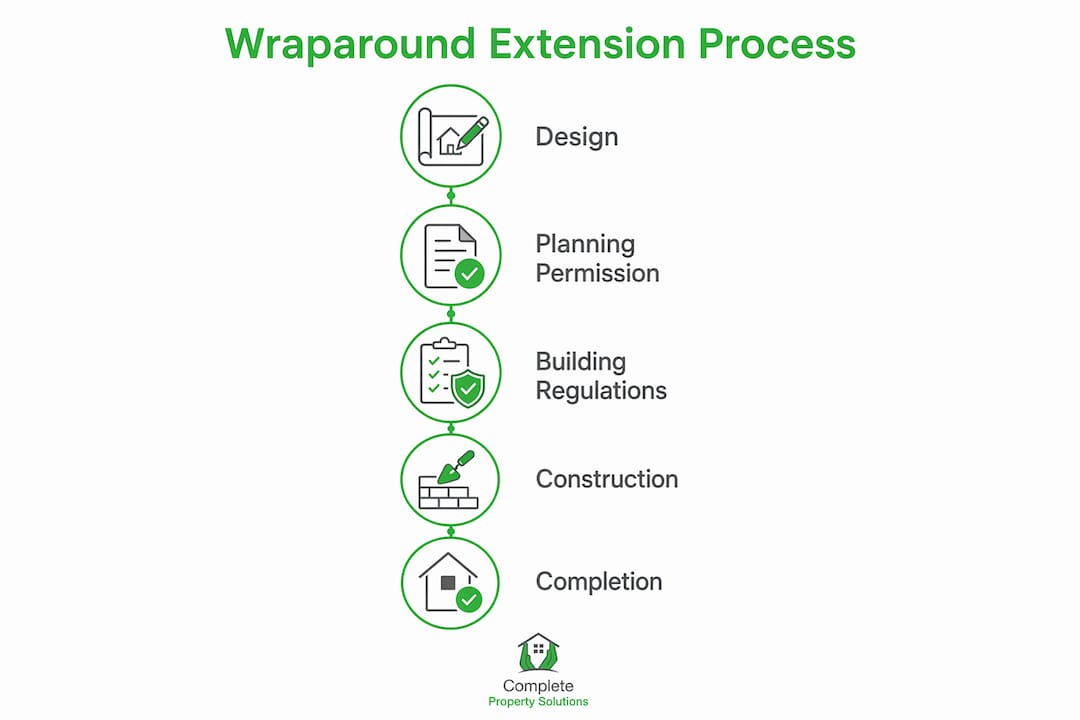
Building Regulations approval is a completely separate process from planning permission. It covers structural integrity, insulation, drainage, and fire safety. A full plans application, rather than a building notice, is strongly recommended for wraparound projects. It requires detailed structural calculations and inspections before construction starts, which prevents costly surprises mid-build.
Hiring an architect to act as your planning agent significantly improves your chances of approval. Architects who manage planning submissions understand local council policy, anticipate objections, and handle revisions without losing weeks to avoidable back-and-forth.
How do you design a wraparound extension for light and space?
The most common design mistake is prioritising floor area over natural light. A large, dark extension adds square footage but reduces the quality of daily life. Good wraparound extension design focuses on rooflights, full-width glazing, and bi-folding or sliding doors to flood the new space with daylight.
Effective layout principles include:
- Open-plan kitchen, dining, and living zones work best when ceiling heights and flooring materials define each area rather than walls.
- Rooflights positioned over the junction between the side return and rear extension solve the darkest part of the L-shape.
- Bi-folding or sliding doors across the rear elevation connect the new space to the garden and make the room feel larger than its footprint.
- Complementary materials on the exterior, such as matching brick or render, prevent the extension from looking like an afterthought.
- Avoid pastiche design that mimics period features unconvincingly. A clean, contemporary addition that respects the original character reads far better than a fake Victorian addition.
Pro Tip: Ask your architect to model the sun path for your specific plot. A south-facing rear elevation with full glazing can overheat in summer. Rooflights with solar control glass and external shading solve this before it becomes a problem.
The junction where the wraparound meets the existing house is the most structurally complex point. Removing existing walls to create an open-plan flow requires steel beams, known as RSJs (Rolled Steel Joists), to carry the load. These must be designed by a structural engineer and approved under Building Regulations. For inspiration on how different extension types connect to existing homes, the ways to extend your living area guide covers the options clearly.
What budget should you expect for a wraparound extension?
A wraparound extension covering 30–50 square metres typically costs between £60,000 and £145,000 in 2026, depending on size, specification, and location. Costs in London sit at the higher end of that range. In the North West, including Warrington, Wigan, and St Helens, you can expect to pay towards the lower to mid-range for a well-specified build.

| Cost category | Typical range |
|---|---|
| Architect and planning fees | £1,600–£3,000 |
| Planning application fee | £548 |
| Structural engineer | £500–£1,500 |
| Foundations and drainage | £5,000–£15,000 |
| Structural steelwork (RSJs) | £3,000–£8,000 |
| Construction and roofing | £35,000–£80,000 |
| Internal fit-out and finishes | £10,000–£25,000 |
| Party Wall Agreement (if needed) | £200–£800 |
The two most common budget surprises are Party Wall Agreements and structural steelwork. Steel beams and party wall costs are frequently underestimated or missed entirely in early quotes. Always ask your builder to itemise these separately.
A well-designed wraparound extension can recover 80–100% of its cost in added property value. That figure depends on quality of finish, local property values, and how well the extension integrates with the existing home. Set aside a contingency of at least 10–15% of your total budget for unforeseen groundwork, drainage diversions, or structural discoveries.
For a detailed breakdown of how extension costs are calculated, the renovation cost guide explains the key variables clearly.
What is the typical timeline for a wraparound extension?
A wraparound extension takes 6–9 months from design to completion, including all approvals and construction phases. Rushing any stage risks quality problems and compliance failures.
A realistic phased timeline looks like this:
- Design and planning approval (8–12 weeks). Your architect prepares drawings, submits the planning application, and manages any council queries. Building Regulations drawings are prepared in parallel.
- Site set-up and groundworks (2–3 weeks). Foundations are dug, drainage is diverted or extended, and the structural engineer’s specifications are confirmed on site.
- Construction phase (14–18 weeks). Walls, roof structure, steelwork, windows, and doors are installed. Building Control inspections happen at key stages throughout.
- Final fit-out (4–6 weeks). Plastering, flooring, kitchen installation, electrical first and second fix, plumbing, and decoration bring the space to a finished standard.
Pro Tip: Appoint your builder before planning permission is granted, not after. A good builder will review the drawings, flag structural issues early, and be ready to start the moment approval lands. Waiting until approval to find a builder adds 6–8 weeks to your timeline.
Delays most commonly come from planning revisions requested by the council, neighbour disputes under the Party Wall Act, and unexpected groundwork discoveries such as old drainage runs or poor ground conditions. Building in programme float at the groundworks and planning stages protects your overall schedule.
Common mistakes to avoid when planning your extension
Most problems on wraparound projects are predictable and preventable. The mistakes below account for the majority of delays, budget overruns, and design regrets seen on real projects.
- Assuming Permitted Development applies. Most wraparounds require full planning permission. Proceeding without confirmation risks enforcement action and costly demolition.
- Skipping a structural engineer. RSJ specifications cannot be guessed. An undersized beam is a Building Regulations failure and a safety risk.
- Choosing a builder before an architect. A builder without drawings cannot give you a reliable fixed price. Get your design right first.
- Ignoring drainage. Wraparounds often cover existing drainage runs. Diverting them adds cost and time if not identified early.
- Delaying the Party Wall notice. You must serve notice on affected neighbours at least two months before work begins. Late notices delay your start date.
- Underspecifying the fit-out. Cheap finishes in a well-built extension reduce both your enjoyment and the property value uplift.
A wraparound extension is one of the most complex single-storey projects a homeowner can undertake. The structural junction, the planning rules, the drainage, and the steelwork all interact. Getting the design and legal groundwork right before you appoint a builder is not caution. It is the only way to protect your budget and your timeline.
For a full checklist of what to prepare before you start, the ten things to know guide covers the pre-build essentials in plain language.
Key takeaways
A wraparound extension requires full planning permission, Building Regulations approval, structural engineering, and a realistic budget of £60,000–£145,000 to deliver a safe, high-quality result.
| Point | Details |
|---|---|
| Planning permission is almost always required | Side returns exceed Permitted Development limits, so a full application costing £548 is standard. |
| Get a Lawful Development Certificate | Even if PD applies, an LDC protects you from legal and mortgage issues at resale. |
| Budget for hidden costs | Party Wall Agreements and RSJ steelwork are frequently missed in early quotes. |
| Design for light, not just size | Rooflights and full-width glazing at the junction deliver far more value than extra floor area. |
| Allow 6–9 months | Rushing planning, structural design, or groundworks creates delays and compliance failures. |
Gareth’s view: what I have learned from building wraparounds in the North West
After more than 35 years building extensions across Warrington, Haydock, Lowton, Great Sankey, and Penketh, the projects I have seen go wrong share one common thread. The homeowner appointed a builder before they had proper drawings, a structural engineer’s input, or a confirmed planning position. The price looked attractive. The timeline sounded fast. Six months later, they were dealing with a planning enforcement notice or a structural beam that failed Building Control inspection.
The wraparound projects that go well start with an architect who understands both the design and the planning process. They involve a structural engineer who sizes the steelwork correctly from day one. And they involve a builder who is transparent about what the groundworks might uncover, rather than one who gives the lowest price and hopes for the best.
I would also say this about budgets. The £60,000–£145,000 range is real, but the figure that matters is the one that includes your contingency. Drainage diversions, unexpected foundations, and party wall surveyor fees are not rare. They happen on the majority of wraparound projects in older North West housing stock. Build them into your budget from the start and you will not be caught short.
The results, when the process is done properly, are genuinely transformative. A well-executed wraparound turns a cramped terrace into a home that feels twice the size, with a kitchen and living space that connects properly to the garden. That is worth doing right.
— Gareth
How Complete-Property-Solutions can help with your wraparound project
Complete-Property-Solutions has delivered wraparound extensions across Warrington, St Helens, Wigan, Rainhill, Great Sankey, Penketh, Culcheth, Lowton, and Haydock for over 35 years. As a Guild of Master Craftsmen member, the company manages every stage of your project, from initial design through to final fit-out, with transparent fixed-price quotations and clear communication throughout.
Whether you are at the early ideas stage or ready to move forward with planning, the team at Complete-Property-Solutions can guide you through design options, planning requirements, structural considerations, and realistic budgets. Visit the house extensions service page for a full overview of what is included, or explore the building a home extension guide to understand the step-by-step process. Get in touch to arrange a consultation and take the first step towards a home that works properly for your family.
FAQ
Does a wraparound extension need planning permission?
Yes, in almost all cases. The side return element of a wraparound extension exceeds Permitted Development width limits, so a full planning application is required. The current application fee is £548.
How long does a wraparound extension take to build?
A wraparound extension takes 6–9 months from design to completion, including 8–12 weeks for planning approval and 14–18 weeks for the construction phase.
What does a wraparound extension cost in the North West?
Costs typically range from £60,000 to £145,000 for a 30–50 square metre wraparound extension. North West projects generally sit towards the lower to mid-range of that figure, depending on specification and site conditions.
Do I need Building Regulations approval as well as planning permission?
Yes. Building Regulations approval is a separate mandatory process covering structural safety, insulation, drainage, and fire safety. A full plans application is strongly recommended for wraparound projects to avoid costly delays during construction.
What is a Lawful Development Certificate and do I need one?
A Lawful Development Certificate is a formal document from your local council confirming that your extension complies with Permitted Development rules. Even when you believe PD applies, obtaining one protects you from legal disputes and mortgage complications when you sell.


