

A well-designed home extension increases a UK property’s value by 10–20%, with multi-room or two-storey projects reaching 23–25% in strong markets. That figure comes from 2026 UK data, and it sets the right expectation before you spend a penny. The formal term professionals use is return on investment (ROI), meaning the increase in property value relative to what you spent building the extension. Understanding this calculation is the foundation of every good extension decision. Location, design, build quality, and local price ceilings all shape the final number. Homeowners in Warrington, St Helens, and Wigan face specific market conditions that make local knowledge as important as the build itself.
What is the return on investment for home extensions?
Return on investment in home extensions is defined as the net increase in property value divided by the total build cost, expressed as a percentage or multiplier. A project costing £60,000 that adds £90,000 to your home’s value delivers a 1.5× ROI. That is the core calculation, and every other factor in this article feeds into it.

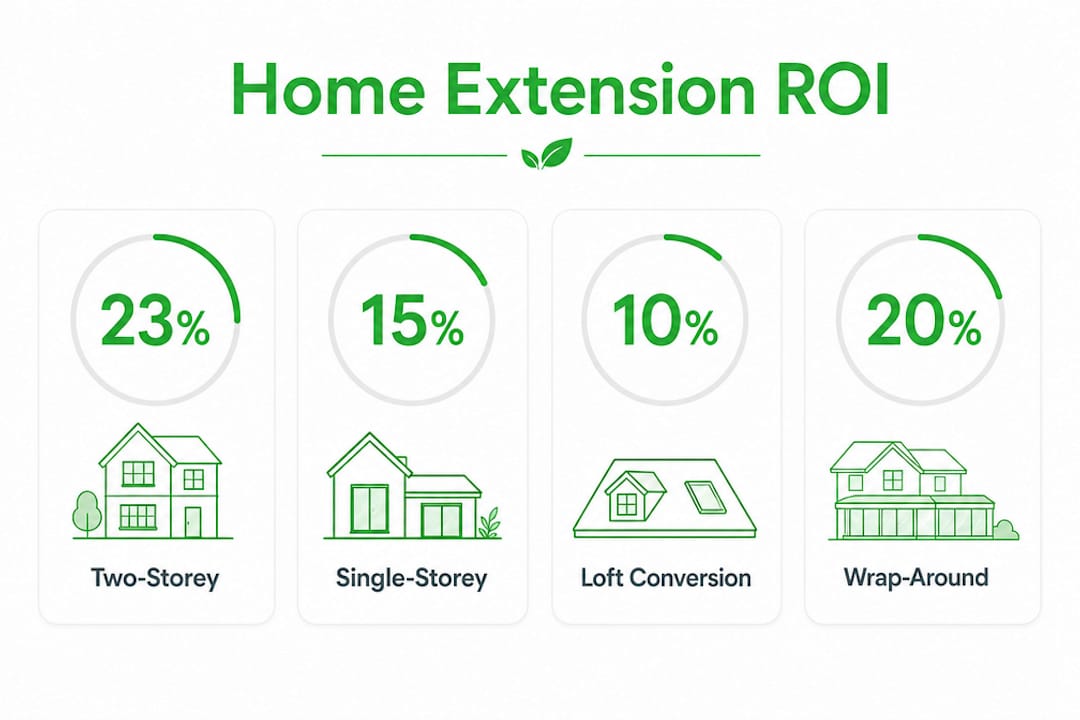
Value uplifts vary by type: single-storey rear extensions add 11–15%, double-storey extensions add 20–23%, and loft conversions add 15–20%. Kitchen-diner extensions typically add 5–15%, depending on how much they improve the home’s layout and liveability. Extensions that add bedrooms or open-plan space consistently deliver the strongest returns because they address what buyers actively search for.
ROI also varies significantly by region. London and South East extensions recoup 130–190% of build costs, while some northern regions recover only 82–105%. That gap matters for homeowners in Warrington, St Helens, and Wigan, where local price ceilings and buyer preferences shape what an extension is actually worth on the open market.
Which extension type gives the best home extension ROI?
Different extension types suit different properties, budgets, and goals. The table below summarises typical cost ranges, value uplifts, and ROI bands for the most common options in the UK market.
| Extension type | Typical build cost | Value uplift | ROI band | Best suited to |
|---|---|---|---|---|
| Single-storey rear | £33,000–£60,000 | 11–15% | 1.1×–1.5× | Most house types |
| Two-storey rear | £80,000–£140,000 | 20–23% | 1.4×–1.8× | Semis and detached |
| Wrap-around | £90,000–£160,000 | 18–22% | 1.4×–1.8× | Corner plots |
| Side-return | £35,000–£65,000 | 8–12% | 1.2×–1.6× | Victorian terraces |
| Loft conversion | £40,000–£80,000 | 15–20% | 1.6×–2.0× | Most house types |
| Garage conversion | £15,000–£35,000 | 10–15% | 1.5×–2.0× | Homes with integral garages |
Two-storey rear extensions yield the highest absolute resale uplift, reaching £140,000–£220,000 in strong markets. Loft conversions, however, deliver the best return per pound spent, with ROI of 1.6×–2.0×. Garage conversions sit alongside loft conversions for efficiency, particularly where the garage is already integrated into the house footprint.
Wrap-around extensions suit corner plots and larger semis. They combine a rear and side-return extension into one project, which reduces the cost per square metre compared to building them separately. Side-return extensions work particularly well on Victorian terraces in areas like Warrington and St Helens, where narrow side passages are common and underutilised space can be converted without touching the garden.
Pro Tip: Match your extension type to both your functional need and local buyer demand. A loft conversion adding a fourth bedroom in a family-friendly area like Culcheth or Lowton will outperform a luxury kitchen extension in the same postcode every time.
What factors affect the value of a home extension?
The postcode price ceiling is the single greatest constraint on extension value. Over-investing relative to comparables is the most common cause of negative ROI. No matter how well-built your extension is, your home cannot sell for more than the highest recent comparable sale in your street or postcode.
Several other factors shape the final return:
- Build quality and design harmony. Poorly designed extensions that clash with the existing architecture can deter buyers and reduce value. A well-matched extension reads as part of the original house.
- Garden space. Reducing garden size in a family-home market can offset the value gained from extra floor space. Side-return extensions avoid this problem by filling unused side passages.
- Specification level. Luxury finishes on mid-market properties deliver disproportionately low returns. Specification should match local buyer expectations, not personal taste.
- Energy efficiency. 2026 Part L Building Regulations require improved insulation and glazing standards. Compliance adds value in the long run, even though it increases upfront cost.
- Layout improvement. Extensions that create open-plan living or add a bedroom deliver more value than those that simply add square footage without improving how the home functions.
Pro Tip: Before committing to a design, check recent sold prices for comparable homes in your postcode on the Land Registry. If the best local sale is £350,000, an extension costing £80,000 on a £290,000 home leaves very little margin.
Planning, regulations, costs, and timescales
Understanding the regulatory and financial picture is as important as choosing the right extension type. Getting this wrong adds cost, delays, and stress.
Planning permission and Permitted Development
Planning permission is usually required for two-storey and wrap-around extensions. Single-storey rear and side-return extensions often proceed under Permitted Development Rights, subject to size limits and prior approval. Permitted Development does not mean no paperwork. You still need to confirm compliance with your local planning authority before work starts.
Building Regulations and 2026 costs
All extensions require Building Regulations approval regardless of planning status. The 2026 update to Part L adds £3,000–£8,000 to build costs for energy efficiency measures, including improved insulation and triple glazing. These costs are mandatory and must be factored into your budget from day one.
Realistic cost ranges and what to budget
- Single-storey rear extension: £33,000–£60,000 for the build, plus professional fees and Building Regulations.
- Two-storey extension: £80,000–£140,000, with structural engineer and planning fees on top.
- Loft conversion: £40,000–£80,000 depending on dormer size and specification.
- Garage conversion: £15,000–£35,000, often the most cost-effective route to extra living space.
- Professional fees, contingency, and compliance: Add 10–25% over the builder’s quote to cover architect fees, structural engineer, party wall surveys, and a sensible contingency.
Comparing extension costs against moving costs is instructive. Stamp duty, agent fees, legal costs, and removal expenses typically add £30,000–£80,000 when upsizing by purchase. An extension avoids all of those costs while keeping you in the home and area you already know.
Build timescales
Build times range from 12 to 26 weeks depending on complexity. A single-storey rear extension typically completes in 12–16 weeks. A two-storey or wrap-around project runs 18–26 weeks. Plan for disruption, particularly if the works affect your kitchen or main living areas.
Common mistakes homeowners in Warrington, St Helens, and Wigan make
Local market knowledge protects your investment. Homeowners in Warrington, St Helens, and Wigan face specific price ceilings and buyer preferences that national guides often overlook.
The most frequent mistakes include:
- Over-investing relative to local comparables. A £120,000 extension on a £220,000 semi in Wigan will not deliver the same return as the same project in a higher-value postcode. Check sold prices first.
- Choosing the wrong extension type for the property. A large rear extension on a terraced house in St Helens that removes most of the garden will put off family buyers, who are the primary market for that property type.
- Underestimating planning timescales. Local planning departments vary in processing speed. Factor in 8–12 weeks for a full planning application and build that into your project timeline.
- Using builders unfamiliar with local regulations. Planning and Building Regulations requirements differ between Warrington Borough Council and St Helens Council. A local specialist avoids costly resubmissions.
- Mismatching specification to buyer expectations. Mid-market buyers in Haydock or Golborne do not expect or pay a premium for high-end marble worktops. Align your finish level with what local buyers actually value.
The benefits of home extensions go beyond financial returns. Gaining extra space without moving, improving how your home functions day to day, and staying in a community you know all have real value that does not show up in an ROI calculation. Consider both when making your decision. Exploring residential addition benefits alongside the financial case gives you the full picture.
Key takeaways
A well-planned home extension delivers 10–25% value uplift, but only when the type, specification, and cost align with your local market ceiling.
| Point | Details |
|---|---|
| ROI depends on extension type | Loft conversions and garage conversions deliver the best return per pound spent at 1.6×–2.0×. |
| Postcode ceiling limits returns | Over-investing beyond local comparable sales is the most common cause of negative ROI. |
| Budget for all costs, not just build | Professional fees and compliance add 10–25% over the builder’s quote. |
| Planning rules vary by type | Two-storey and wrap-around extensions need full planning permission; single-storey often qualifies for Permitted Development. |
| Local market knowledge is critical | Homeowners in Warrington, St Helens, and Wigan should check local sold prices before committing to a design. |
What I’ve learned after 35 years of building extensions
The numbers matter, but they rarely tell the whole story. I have seen homeowners chase the highest ROI figure on paper and end up with an extension that does not suit how they actually live. A two-storey rear extension might look great on a spreadsheet, but if your family needs a practical kitchen-diner and a utility room, a well-designed single-storey project will serve you better and cost considerably less.
The timing of the local market is something most guides ignore entirely. If comparable sales in your street have been flat for 18 months, the value uplift from your extension will be modest regardless of how well it is built. Conversely, in a rising market, a well-executed project can outperform even the most optimistic projections.
My strongest advice is this: design for how you want to live first, then check the numbers. Extensions built purely for resale often feel functional but cold. Extensions built for the family that lives in them tend to be the ones buyers fall in love with when the time comes to sell. The two goals are not in conflict. They just need to be considered in the right order.
One more thing that rarely gets mentioned: the quality of your builder affects your ROI directly. A poorly built extension with visible defects, damp issues, or non-compliant Building Regulations work will be flagged in a buyer’s survey and can reduce your sale price by more than the cost of doing it properly in the first place.
— Gareth
Planning your extension with Complete-Property-Solutions
Complete-Property-Solutions has been building home extensions across Warrington, St Helens, Wigan, and the wider North West for more than 35 years. As members of the Guild of Master Craftsmen, the team manages every project from initial design through to final completion, including planning applications, Building Regulations compliance, and fixed-price quotations with no hidden costs.
Whether you are considering a single-storey rear extension or a full two-storey project, Complete-Property-Solutions provides the local knowledge and build quality that protects your investment. The team also covers garage conversions for homeowners looking for a high-ROI route to extra living space without a full extension. Get in touch to discuss your project and receive a transparent, fixed-price quote tailored to your home and postcode.
FAQ
What is the average ROI for a home extension in the UK?
A well-designed home extension typically increases property value by 10–20%, with two-storey and multi-room projects reaching 23–25% in strong markets. ROI expressed as a multiplier ranges from 1.1× for basic single-storey projects to 2.0× for loft conversions.
Do home extensions add more value than they cost?
In most cases, yes, particularly in areas with rising property values. Extensions also avoid stamp duty and moving costs of £30,000–£80,000, which improves the net financial case compared to upsizing by purchase.
Do I need planning permission for a home extension?
Single-storey rear and side-return extensions often qualify for Permitted Development Rights, subject to size limits. Two-storey and wrap-around extensions usually require full planning permission from your local authority.
How long does a home extension take to build?
Build times range from 12 to 26 weeks depending on complexity. A single-storey rear extension typically completes in 12–16 weeks, while a two-storey project runs 18–26 weeks.
Are home extensions worth it in Warrington, St Helens, and Wigan?
Extensions in these areas can deliver strong returns when the type and cost align with local comparable sales. The key is to check your postcode price ceiling before committing, and to work with a builder who understands local planning requirements and buyer expectations.


