

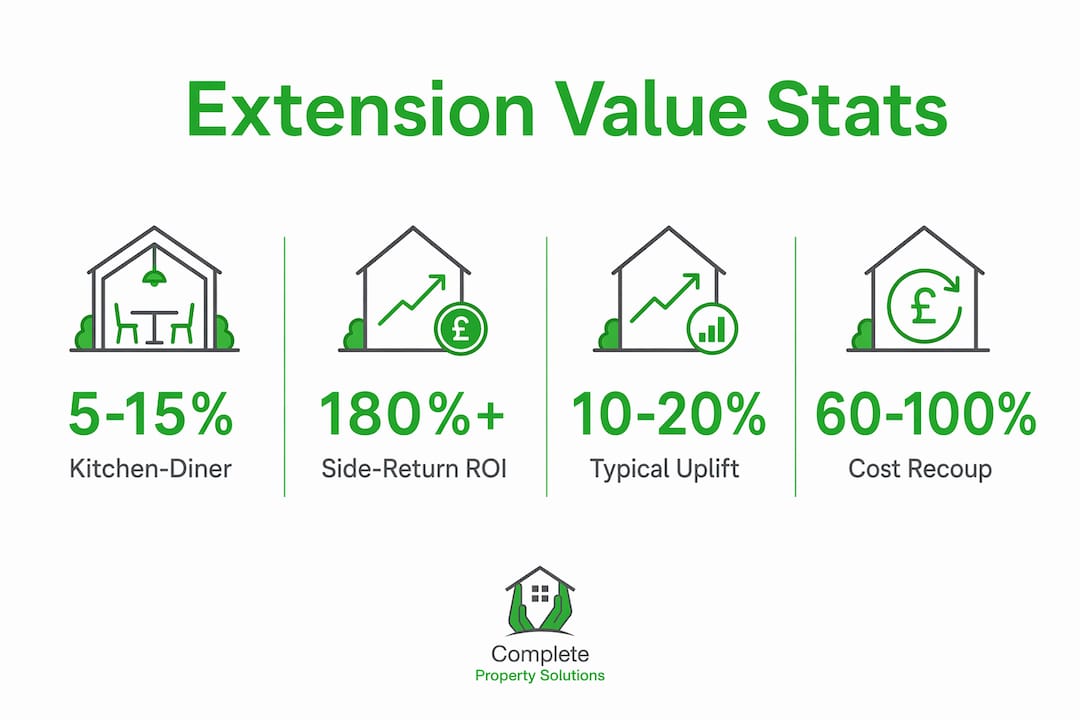
A well-designed home extension is one of the most reliable ways to increase your property’s value in the UK. Research shows that extensions typically add 10–20% to a property’s value, with certain types pushing that figure even higher. Understanding how extensions increase property value means looking beyond the build itself. The type of extension, the quality of workmanship, local market conditions in areas like Warrington, St Helens, and Wigan, and compliance with Building Regulations all shape the final return. Get these factors right, and an extension pays for itself many times over.
!
How do extensions increase property value?
A home extension increases property value by adding usable floor space, improving the layout, and making the property more attractive to buyers. Estate agents and surveyors assess value primarily on floor area and the number of functional rooms, so adding square metres directly affects the asking price. Beyond the numbers, a well-executed extension changes how a home feels. Open-plan kitchen-diners, for example, are among the most sought-after features in the current market, and buyers will pay a premium for them.

Our apprentice helping construct the new timber orangery roof under the supervision of our experienced team during a home extension project in Frodsham.
The impact of home extensions on resale value is not automatic, though. A poorly designed or over-specified extension can actually deter buyers. The key is matching the extension to the property type, the street, and what local buyers genuinely want. That is why understanding the relationship between extension type, cost, and local demand is the starting point for any sensible decision.
What types of extensions add the most value?
Different extension types deliver different returns. The table below gives a practical overview based on current UK market data.
| Extension type | Typical cost (2026) | Value added | Typical build time |
|---|---|---|---|
| Kitchen-diner extension | £35,000–£55,000 | 5–15% | 10–14 weeks |
| Single-storey rear extension | £35,000–£65,000 | 5–12% | 8–12 weeks |
| Two-storey extension | £60,000–£120,000 | 10–20% | 14–20 weeks |
| Wraparound extension | £60,000–£130,000 | 10–20% | 16–24 weeks |
| Garage conversion | £12,000–£21,000 | 10–15% | 2–4 weeks |
Kitchen-diner extensions
Kitchen-diner extensions add 5–15% to a property’s value and can recoup 60–100% of build costs when aligned with local market standards. That recoup rate depends heavily on specification. A kitchen extension in Culcheth or Great Sankey needs to reflect what buyers in those areas expect, not what a London showroom would feature. Overspending on finishes in a mid-market area is one of the most common mistakes homeowners make.
Wraparound and two-storey extensions
Side-return extensions deliver ROI upwards of 180% by unlocking functional space without significant garden loss. Two-storey extensions add the most floor area for the build cost, making them the strongest performer for value uplift as a percentage of spend. They suit semi-detached and detached homes in areas like Lowton, Haydock, and Rainhill, where buyers expect generous room sizes.
Garage conversions
Garage conversions cost £12,000–£21,000 and complete in 2–4 weeks, compared to 10–16 weeks for a full extension. That speed and cost advantage makes them the most accessible route to adding a bedroom, home office, or playroom. Converting a garage to a bedroom with an ensuite is particularly effective for value uplift. One important caveat: in certain markets, particularly for larger detached homes where covered parking is valued, a garage conversion can reduce buyer appeal rather than increase it.
Pro Tip: Before committing to a garage conversion, check recent sales of similar properties on your street. If most sold homes retained their garage, buyers in your area likely value parking over extra living space.
!
What design and construction factors affect value uplift?
Build quality is the single biggest factor separating extensions that add value from those that do not. A poorly built extension with visible damp, cold bridging, or mismatched materials will be flagged in a buyer’s survey and can reduce the sale price below the pre-extension value. High-quality workmanship, by contrast, gives buyers confidence and supports a higher asking price.
Several design principles consistently improve buyer appeal:
- Natural light. Bi-folding doors, roof lanterns, and skylights make extensions feel larger and more welcoming. Buyers respond strongly to light-filled spaces.
- Open-plan layouts. Removing internal walls to create a kitchen-diner-living area is the most requested layout change in UK residential property.
- Energy efficiency. Extensions built to 2026 Part L Building Regulations standards, including enhanced insulation and mechanical ventilation, reduce running costs. Buyers increasingly factor energy bills into purchase decisions.
- Design harmony. An extension that clashes with the original property in materials, scale, or style reduces kerb appeal. Matching brickwork, roof pitch, and window styles matters.
Over-extending or poor design deters buyers despite added floor area. Losing too much garden space is a common example. A large extension that leaves a postage-stamp garden will put off families, who represent a significant share of buyers for three and four-bedroom homes in areas like Penketh and Croft.
Pro Tip: Ask your builder to produce a scaled floor plan before work begins. Seeing the layout on paper reveals awkward proportions and wasted space that are difficult to spot on site.
!
Planning, costs, and Building Regulations: what you need to know
Most single-storey rear extensions fall under Permitted Development rights in England, meaning you do not need full planning permission. However, there are size limits: single-storey extensions must not exceed 4 metres in depth for detached homes or 3 metres for semi-detached and terraced properties under standard Permitted Development. Larger extensions require a Householder Planning Application, which typically takes 8 weeks to determine.
Every extension, regardless of planning status, must comply with Building Regulations. In 2026, the key changes affect energy performance. Part L Building Regulations now require triple glazing, mechanical ventilation, and detailed thermal bridging specifications. These requirements add approximately £3,000–£8,000 to build costs but also improve the property’s Energy Performance Certificate rating, which supports resale value.
A realistic budget for a home extension in the North West of England in 2026 should account for the following:
- Structural work. RSJ installations, foundations, and groundwork typically represent 20–30% of total build cost. Understanding foundation costs for extensions helps you budget accurately from the outset.
- Building Regulations compliance. Budget £3,000–£8,000 for 2026 Part L requirements on top of the base build cost.
- Professional fees. Architect or designer fees, structural engineer calculations, and Building Control fees typically add 10–15% to the project cost.
- Contingency. A 10–15% contingency fund covers unexpected groundwork issues, material price changes, and design amendments.
Industry guidance recommends spending no more than 10–15% of your current home value on any single improvement to protect your financial return. On a £250,000 property in Wigan or St Helens, that means keeping the extension budget at or below £37,500 to maintain a sensible return on investment. Exceeding that threshold is not always wrong, but it requires a clear understanding of your local market ceiling.
For a practical overview of what to consider before breaking ground, the guide on things to know before building covers the key decisions in plain language.
!
How does location affect the return on extension investment?
Location shapes extension ROI more than any other single factor. Regional disparities mean London and the South East consistently deliver higher returns than the North West, where market ceilings are lower. That does not mean extensions are poor investments in Warrington, St Helens, or Wigan. It means the type and scale of extension must be matched carefully to what the local market will support.
Every street has a price ceiling. Understanding local recent sales is the most reliable way to assess whether an extension will push your property above the ceiling or comfortably within it. If the most expensive homes on your road sell for £350,000 and your property is already worth £320,000, a £60,000 extension is unlikely to return its full cost.
Key points to consider when assessing local market conditions:
- Consult a local estate agent before committing to a large project. Local agent consultations help identify market ceilings and buyer preferences specific to your area.
- Check sold prices on Rightmove or the Land Registry for comparable properties on your street with and without extensions.
- Consider buyer demographics. Families in Golborne or Ormskirk prioritise bedrooms and garden space. Professionals in Worsley or Southport may value home offices and open-plan living more highly.
- Think long term. Extensions serve both personal benefit and investment purposes. If you plan to stay for ten or more years, the lifestyle improvement justifies the spend even where the immediate ROI is modest.
For a broader view of which improvements deliver the strongest returns in the current market, the 2026 ROI guide compares extension types against other home improvements.
Key takeaways
Well-designed extensions add 10–20% to UK property value, but the return depends on extension type, build quality, local market conditions, and compliance with 2026 Building Regulations.
| Point | Details |
|---|---|
| Value uplift range | Extensions typically add 10–20%, with bedroom additions reaching up to 24% in the right market. |
| Best value extension type | Garage conversions offer the strongest cost-to-value ratio at £9,000–£20,000 for a 10–15% uplift. |
| Budget discipline | Spend no more than 10–15% of your current home value to protect your financial return. |
| Design quality matters | Poor layouts, garden loss, and mismatched materials reduce buyer appeal despite added floor area. |
| Location sets the ceiling | Check local sold prices before committing; every street has a maximum value that limits extension ROI. |
Gareth’s view: what 35 years of building extensions has taught me
After more than three decades of building extensions across Warrington, St Helens, and Wigan, the question I hear most often is: “Will this add value?” My honest answer is always the same. It depends on what you build, how well you build it, and whether it suits the street.
The biggest mistake I see is homeowners chasing the biggest possible extension rather than the right one. A two-storey extension on a modest terraced house in a street where nothing sells above £200,000 will not return its cost. A well-executed kitchen-diner on the same house, built to a high standard with good natural light and quality finishes, very likely will.
I also think the lifestyle argument is underrated. Most of our clients in Culcheth, Penketh, and Haydock are not moving for another ten to fifteen years. The extension they build today improves their daily life for all of those years. The value uplift at sale is a bonus, not the whole story. Build for how you want to live, choose a builder with a proven track record, and the numbers tend to take care of themselves.
— Gareth
Planning an extension? Complete-Property-Solutions can help
Complete-Property-Solutions has been building extensions across Warrington, St Helens, Wigan, and the wider North West for more than 35 years. As members of the Guild of Master Craftsmen and approved HUP! Building System partners, the team manages every project from initial design through to Building Control sign-off, with transparent fixed-price quotations and no hidden costs.
Whether you are considering a kitchen or wraparound extension, a garage conversion, or a full home renovation, Complete-Property-Solutions provides the expertise and local knowledge to help you make the right decision for your property and your budget. Get in touch for a free, no-obligation consultation and find out exactly what your home could achieve.
FAQ
How much value does a home extension add in the UK?
A well-designed extension typically adds 10–20% to a UK property’s value, with bedroom additions reaching up to 24% in the right market conditions.
Do I need planning permission for a home extension?
Most single-storey rear extensions fall under Permitted Development rights in England and do not require full planning permission, provided they meet size limits. Larger or two-storey extensions require a Householder Planning Application.
Are garage conversions worth it for adding property value?
Garage conversions add 10–15% value at a fraction of the cost of a full extension, making them excellent value. However, in markets where off-street parking is highly valued, they can reduce buyer appeal for larger detached homes.
What is the biggest mistake homeowners make with extensions?
Over-extending or poor design is the most common mistake. Losing garden space, creating awkward layouts, or spending beyond the local market ceiling reduces buyer appeal and can harm resale value.
How long does a home extension take to build?
Timescales vary by type. Garage conversions complete in 2–4 weeks. Single-storey extensions take 8–12 weeks. Two-storey and wraparound extensions typically take 14–24 weeks from groundworks to completion.


