

An orangery is defined as a hybrid home extension combining solid brick or masonry walls with large glazed panels and a central lantern roof, sitting architecturally between a full extension and a conservatory. Planning an orangery home addition requires you to navigate permitted development rights, Building Regulations approval, and design decisions that affect both comfort and long-term value. Get these three areas right from the start, and you will avoid the costly mistakes that catch many homeowners off guard.
What planning permission do you need for an orangery?
Orangeries in England are classified as single-storey extensions and commonly fall under permitted development rights, meaning you may not need a formal planning application at all. However, permitted development is not a blanket exemption. Specific limits apply: a maximum height of 4 metres (3 metres if within 2 metres of a boundary), no more than half the garden covered by extensions, and materials that closely match the existing house. Exceeding any one of these thresholds triggers the need for full planning permission.
Certain properties carry additional constraints regardless of size. Conservation areas, listed buildings, and national parks all require special consent, and materials must match historic styles. If your property falls into any of these categories, contact your local planning authority before commissioning any design work. Discovering this after paying for detailed drawings is an expensive and avoidable lesson.
The Party Wall etc. Act 1996 adds another legal layer that many homeowners overlook entirely. Under Section 6, you must serve formal notice at least one month before any excavation within 3 metres of a neighbour’s structure (or 6 metres at a 45-degree angle). Ignoring this can halt your project mid-build and expose you to legal liability.
| Scenario | Planning permission required? | Key conditions |
|---|---|---|
| Standard detached or semi-detached home | Usually not (permitted development) | Max 4m height, under half garden covered, matching materials |
| Within 2m of boundary | Usually not, with reduced height limit | Max 3m height |
| Conservation area or listed building | Yes, special consent required | Materials and design must match historic character |
| Orangery exceeding size limits | Yes, full application needed | Submit to local planning authority |
| Excavation near neighbour’s structure | Party Wall Act notice required | Serve notice at least one month before work begins |
Homeowners frequently underestimate permitted development limitations, so verifying your eligibility early saves wasted design costs. A quick call to your local authority or a planning permission check with a specialist takes hours, not weeks, and protects your entire budget.
How do building regulations affect your orangery design?
Building Regulations approval is required for most orangery projects due to their substantial construction, roof types, and direct integration with the existing home. This is the point where many homeowners make a critical error: they assume that because planning permission is not needed, no formal approvals apply. Planning permission and Building Regulations are entirely separate approvals, and passing one does not guarantee passing the other.
The regulations cover five core areas:
- Structural integrity: Foundations, walls, and the roof structure must meet load-bearing standards.
- Ventilation: Adequate air flow must be designed in from the outset, particularly for open-plan connections to the main house.
- Insulation: Thermal performance must meet defined targets throughout the build.
- Energy efficiency: Approved Document L 2026 sets mandatory U-value targets: 0.16 W/m²K for roofs, 0.26 W/m²K for walls, and 0.18 W/m²K for floors. These figures represent the maximum heat loss permitted per square metre, and meeting them requires careful specification of insulated roof panels, cavity wall insulation, and thermally broken glazing frames.
- Integration with existing systems: Heating and ventilation connections to the main house must be planned and approved.
You can explore Building Regulations compliance in detail before committing to a design, which helps you spec materials accurately from day one rather than retrofitting costly upgrades later.
Pro Tip: Plan insulation continuity at every junction, particularly where the orangery roof meets the existing wall and at window reveals. These junctions are the most common source of condensation and thermal bridging, and fixing them after construction is far more expensive than detailing them correctly at the design stage.
Designing your orangery: roof options, glazing, and thermal comfort
An orangery combines solid masonry with large glazed panels and a central lantern roof, and the proportions you choose between brickwork and glass define both the character of the space and its thermal performance. More glazing brings more light but demands higher-specification glass to maintain energy efficiency. More brickwork provides better insulation and gives you more flexibility for integrating sockets, lighting, and heating vents within the structure.
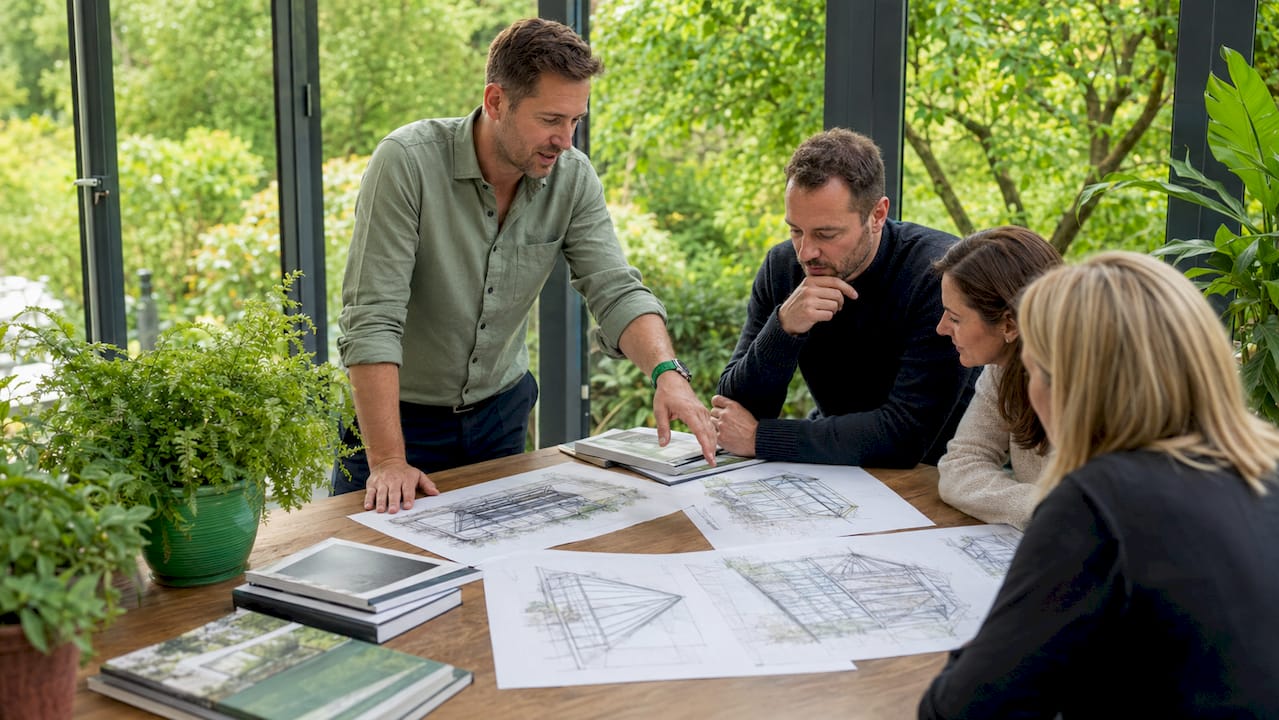
The roof is the single most consequential design decision you will make. Three main options exist, each with distinct trade-offs:
| Roof type | Key benefit | Key consideration |
|---|---|---|
| Glazed lantern roof | Maximises natural light, classic orangery appearance | Requires high-performance glazing to meet Part L U-values |
| Solid insulated roof | Best thermal performance, suitable for year-round use | Reduces overhead light; may need roof lights for brightness |
| Tiled pitched roof | Matches existing house style, excellent insulation | Higher structural load; requires stronger foundations |
Double glazing meets minimum standards, but triple glazing is increasingly specified in 2026 builds where the orangery is intended as a year-round living space rather than a seasonal room. The difference in comfort during a January morning in Warrington or Wigan is significant. Thermally broken aluminium or uPVC frames reduce cold bridging at the glazing perimeter, which is where heat loss concentrates in poorly specified builds.
Open-plan orangery designs require careful detailing for insulation continuity and ventilation to prevent condensation and meet regulations. Junctions between the orangery roof and the existing house wall are particularly vulnerable. Specifying a continuous insulation layer across this junction, rather than treating the two structures independently, is the difference between a comfortable room and one that sweats in winter.
For design inspiration specific to your area, modern orangeries in Cheshire and Lancashire show how brickwork and glazing proportions can be tailored to both traditional and contemporary homes without compromising thermal performance.
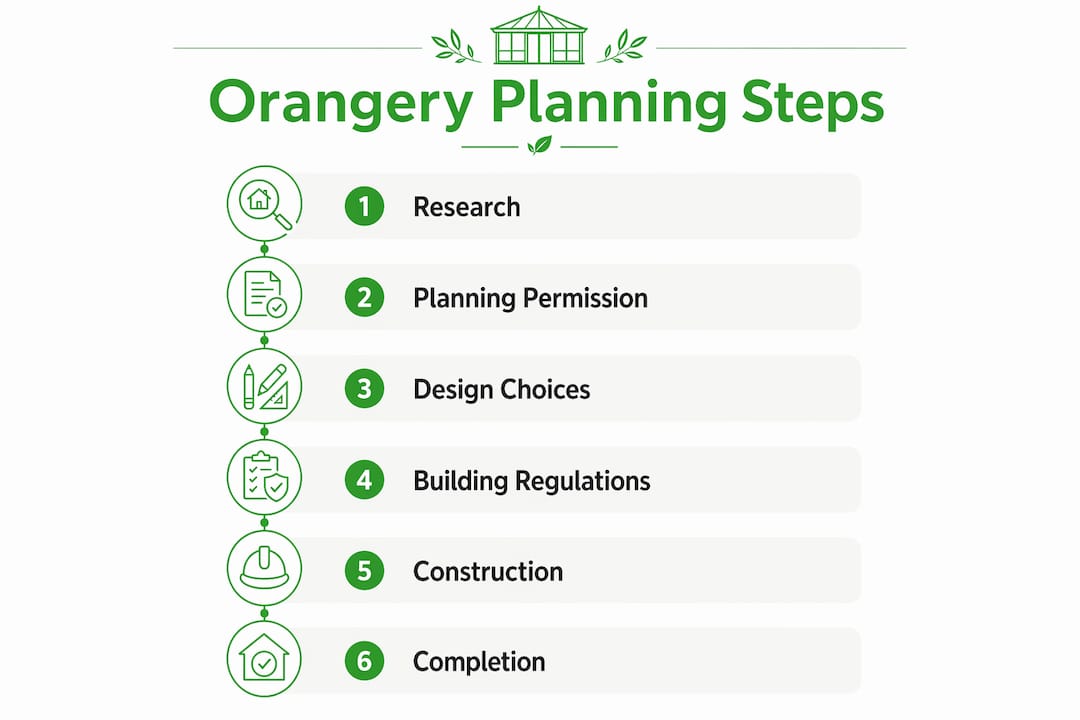
Step-by-step guide to planning and executing your orangery project
A well-run orangery project follows a clear sequence. Skipping steps, particularly in the early stages, is where budgets overrun and timelines collapse.
- Assess your site. Measure the available space, check boundary distances, and identify any drainage, utilities, or tree root zones that could affect foundations.
- Verify planning status. Confirm whether permitted development applies or whether a full application is needed. Check for conservation area or listed building designations.
- Commission a foundation assessment. Early site investigation identifies Party Wall Act obligations before design costs accumulate. If excavation will come within 3 metres of a neighbour’s structure, serve the required notice immediately.
- Set your budget. Include design fees, planning application costs (if required), Building Regulations fees, construction, and a contingency of at least 10 to 15 per cent.
- Appoint a designer and builder. Work with professionals who understand both the aesthetic and regulatory requirements. Review ten things to know before building to prepare for your first consultation.
- Submit for Building Regulations approval. This runs parallel to or immediately after any planning application. Do not wait for one to complete before starting the other.
- Construction and inspection. A Building Control officer will inspect at key stages: foundations, damp proof course, structural frame, and completion.
- Snagging and handover. Walk through the finished space with your builder before signing off. Check glazing seals, ventilation openings, and heating connections.
Pro Tip: Commission your foundation and site assessment before finalising the design. Discovering that your intended footprint triggers Party Wall Act obligations after you have paid for detailed architectural drawings adds weeks of delay and unnecessary cost.
Common mistakes to avoid:
- Assuming permitted development applies without checking boundary distances and garden coverage
- Specifying glazing that meets minimum standards rather than 2026 Part L targets
- Failing to detail insulation continuity at roof-to-wall junctions
- Overlooking ventilation requirements for open-plan connections to the main house
- Starting construction before Building Regulations approval is confirmed
Key takeaways
Successful planning of an orangery home addition depends on resolving planning permission, Building Regulations, and design specification in that order before any construction begins.
| Point | Details |
|---|---|
| Permitted development has firm limits | Check height, boundary distance, and garden coverage before assuming no planning permission is needed. |
| Building Regulations apply separately | Most orangeries require Building Regulations approval even when planning permission is not needed. |
| Part L 2026 sets U-value targets | Roofs must achieve 0.16 W/m²K, walls 0.26 W/m²K, and floors 0.18 W/m²K for compliance. |
| Roof choice drives thermal performance | Solid insulated roofs offer the best year-round comfort; lantern roofs require high-specification glazing to compensate. |
| Early site assessment prevents delays | Commissioning a foundation assessment before design finalisation avoids costly Party Wall Act complications. |
Why I always say: sort the regulations before you fall in love with the design
After working on home extensions across Warrington, St Helens, and the wider North West for over 35 years, the pattern I see most often is this: a homeowner finds a beautiful orangery design online, falls completely in love with it, and then discovers three months later that their site, boundary distances, or conservation area status makes that exact design impossible without significant changes. By that point, they have already paid for drawings and, in some cases, ordered materials.
My honest advice is to treat the regulatory groundwork as the creative foundation, not the administrative obstacle. Knowing your permitted development limits and your Part L U-value targets before you choose your roof type means every design decision you make is one that will actually get built. It also means your builder can price the job accurately from the start, which is where fixed-price guarantees become genuinely valuable rather than just a marketing phrase.
The other thing I would say is this: do not underspecify the glazing to save money upfront. An orangery that is too cold to use in winter or too hot in summer is not an extension of your living space. It is a very expensive storage room. Triple glazing and a well-insulated roof panel add cost at the specification stage, but they are far cheaper than retrofitting thermal upgrades after the build is complete. The homeowners I see most satisfied with their orangeries are those who prioritised thermal comfort alongside aesthetics from day one.
— Gareth
How Complete-property can help you plan and build your orangery
Complete-property has been delivering bespoke home extensions across Warrington, St Helens, Wigan, Southport, and surrounding areas for over 35 years. Our team handles every stage of your orangery project, from initial design and planning permission checks through to Building Regulations approval and construction, with a fixed-price guarantee so you always know exactly where you stand.
If you are ready to explore your options, our house extensions service covers orangeries, conservatories, and full home extensions with the same personalised approach and five-star craftsmanship our customers trust. You can also explore our end-to-end extension service to see how we manage the full project lifecycle. Get in touch today for a friendly, no-obligation conversation about your orangery plans.
FAQ
Do I need planning permission for an orangery?
Most orangeries fall under permitted development rights and do not require planning permission, provided they meet size, height, and materials conditions. Properties in conservation areas or listed buildings always require special consent regardless of size.
What is the difference between an orangery and a conservatory?
An orangery uses solid brick or masonry walls with glazed panels and a lantern roof, while a conservatory is predominantly glazed. This structural difference means orangeries typically require Building Regulations approval, whereas some conservatories are exempt.
How much does it cost to build an orangery?
Costs vary significantly based on size, roof type, glazing specification, and location, but a well-specified orangery with a solid insulated roof and triple glazing will typically cost more than a basic conservatory due to the additional structural and insulation requirements.
Do orangeries need Building Regulations approval?
Yes. Most orangery projects require Building Regulations approval covering structural stability, insulation, ventilation, and energy efficiency, even when planning permission is not needed. Building Regulations and planning permission are separate processes.
Can I use DIY orangery plans to build my own?
DIY orangery plans are available, but Building Regulations approval requires professionally assessed structural and insulation specifications. Most homeowners use a qualified builder to manage compliance, particularly for foundations, glazing U-values, and roof-to-wall junctions.
Recommended
- Modern Orangeries Cheshire Lancashire
- The Difference Between a Conservatory and an Orangery – Complete Property Solutions
- House Extensions Home Extensions
- Building a Home Extension


