

Choosing between a garden room and a conservatory comes down to how you plan to use the space, your budget, and how much of your garden you are willing to give up. Garden rooms offer superior year-round insulation and flexibility as standalone structures, while conservatories provide bright, light-filled spaces attached directly to your home, typically at a lower entry cost. Neither is universally better. The right choice depends on your priorities.
| Feature | Garden room | Conservatory |
|---|---|---|
| Structure type | Detached, standalone building | Attached glass extension |
| Roof type | Insulated solid roof | Glass or polycarbonate |
| Typical cost | £15,000–£40,000 (DIY from £5,800) | £15,000–£45,000 |
| Planning permission | Usually permitted development | Usually permitted development |
| Building Regulations | Exempt under 15m²; conditional 15–30m² | Exempt under 30m² with conditions |
| Insulation and usability | Excellent, year-round | Poor without upgrades |
| Maintenance | Low to medium | Higher (glass cleaning, roof repairs) |
| Value-adding potential | Strong | Moderate |
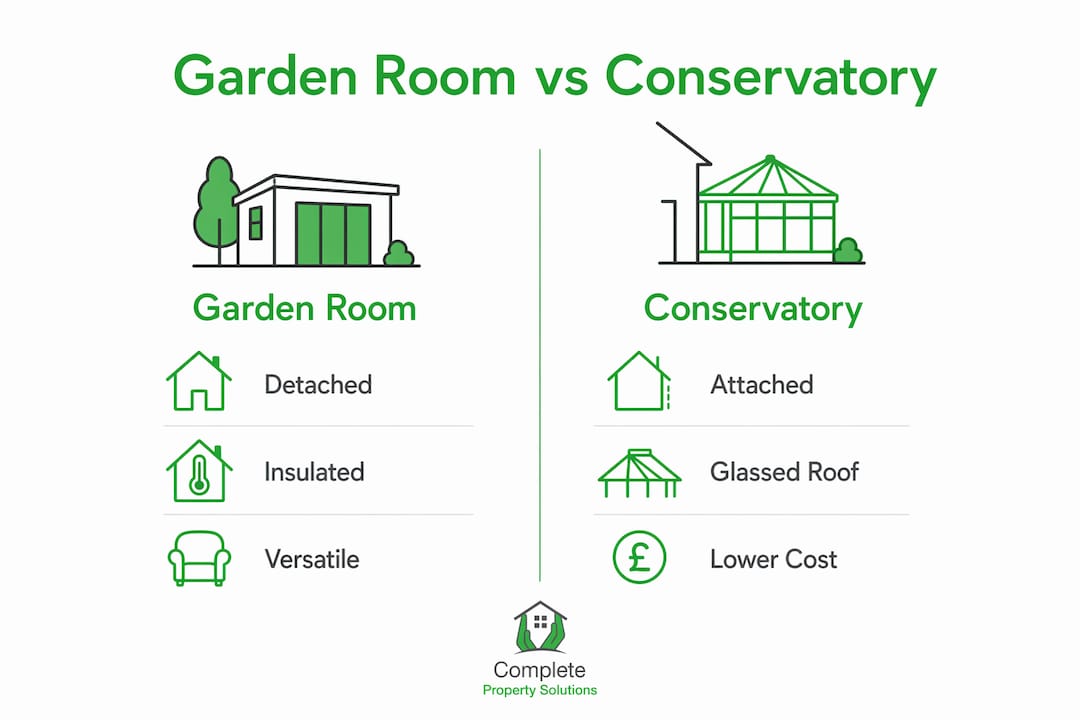
What is the difference between a garden room and a conservatory?
A garden room is a fully insulated, standalone building that sits within your garden, separate from the main house. It functions as an independent room with solid walls, a proper roof, and heating, making it genuinely usable in January just as comfortably as in July. A conservatory, by contrast, is an attached glass extension built directly onto your home, with glazed walls and a glass or polycarbonate roof that floods the space with natural light.
The core distinction is attachment and thermal performance. Conservatories are part of the house footprint; garden rooms consume garden space but leave the house structure untouched. That difference shapes everything from planning rules to how warm the room feels in February.
- Garden rooms: detached, fully insulated, bespoke buildings in the garden
- Conservatories: attached glazed extensions with extensive glass walls and roofs
- Garden rooms suit daily, year-round use; conservatories suit seasonal, sunlit leisure
- Conservatories extend the house footprint; garden rooms reduce available garden area
- Both can usually be built under permitted development rights
How do construction and insulation compare?
Garden rooms are typically built using structural timber frames with insulated panels, achieving wall U-values around 0.15 W/m²K and roof U-values around 0.12 W/m²K. Those figures are comparable to a well-built modern home. Conservatories, with glass roofs, typically sit at around 2.8 W/m²K for the roof alone, meaning heat escapes far more quickly.
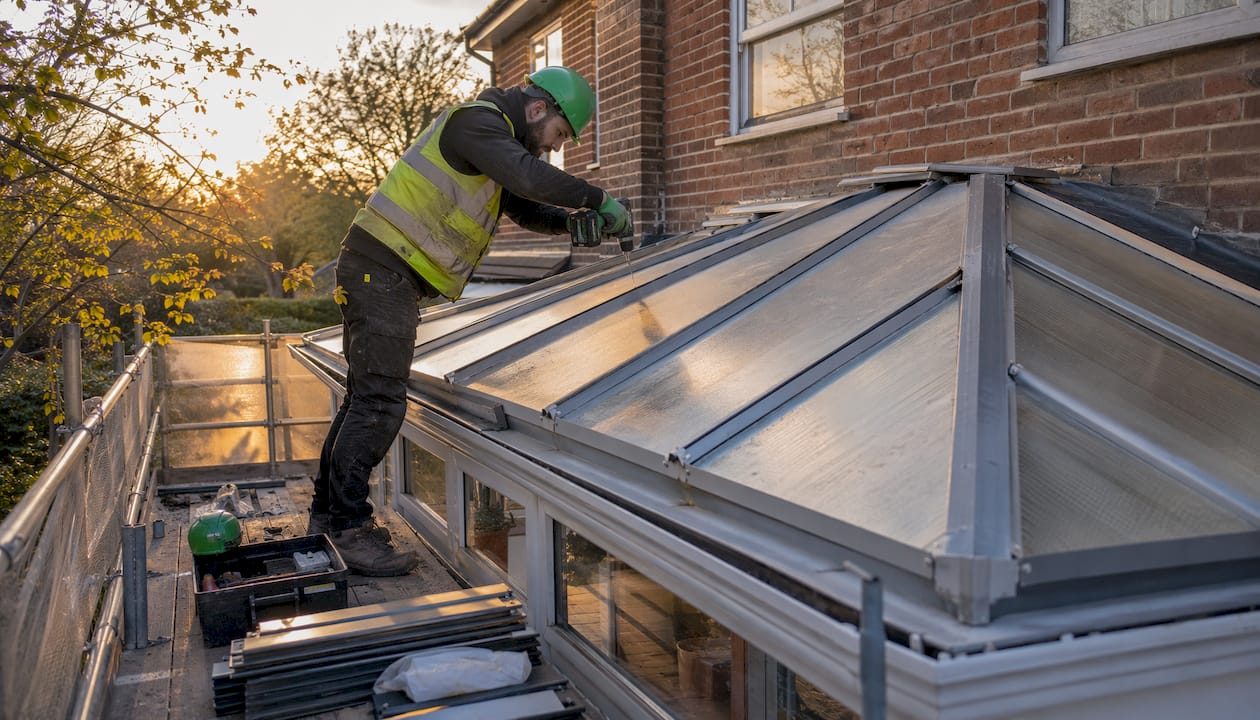
Conservatory roof technology has improved. Complete-Property-Solutions installs the UltraRoof system, a tiled insulated replacement roof that transforms an existing conservatory into a genuinely warm, usable room. REHAU window and door systems, which Complete-Property-Solutions is an authorised installer of, further improve thermal efficiency when fitted to conservatory frames. These upgrades close the gap considerably, though they add cost.
- Garden rooms: timber or SIP (structural insulated panel) frames, solid insulated roofs
- Conservatories: aluminium or uPVC frames, glass or polycarbonate roofs
- Garden room walls and roofs meet modern thermal standards from the outset
- Standard conservatory glass roofs lose heat rapidly in colder months
- UltraRoof and REHAU upgrades can significantly improve conservatory performance
- Cladding choices for garden rooms affect both appearance and durability; quality cladding advice helps you choose materials that last
Pro Tip: If you already have a conservatory that feels unusable in winter, a UltraRoof replacement is often more cost-effective than demolishing and rebuilding. Complete-Property-Solutions can advise on whether your existing structure is suitable.
What does each option actually cost?
Professionally built, insulated garden rooms generally range from £15,000 to £40,000, with basic timber DIY kits starting from around £1,800. Conservatories typically cost between £10,000 and £30,000 depending on size, glazing specification, and frame material. The conservatory entry price is lower, but ongoing costs can close that gap.
| Option | Typical upfront cost | Key ongoing costs |
|---|---|---|
| Garden room (DIY kit) | From £1,800 | Wood treatment every few years |
| Garden room (professional) | £15,000–£40,000 | Minimal; low energy bills |
| Conservatory (standard) | £10,000–£30,000 | Glass cleaning, roof repairs |
| Conservatory roof upgrade | £8,000–£12,000 | Reduced heating costs after |
Prices across Warrington, St Helens, and Wigan broadly reflect national averages, though local labour rates and site access can affect the final figure. A bespoke garden room with bi-folding doors and full electrics at the higher end of the scale represents a very different product from a basic timber shed, so comparing like for like matters.
Planning permission and Building Regulations: what you need to know
Most garden rooms and conservatories can be built under permitted development rights without formal planning permission, but the rules carry specific conditions. Single-storey structures must stay under 2.5m in height near boundaries, and total outbuildings must not cover more than 50% of the land around the original house.
Planning permission and Building Regulations are separate requirements. Satisfying one does not mean you satisfy the other. A conservatory under 30m² is generally exempt from Building Regulations provided it is thermally separated from the house and its heating is independent. The moment you connect the house heating system to the conservatory, that exemption is lost. Similarly, adding a structural opening between the house and an exempt conservatory triggers Building Regulations approval for that opening.
- Garden rooms under 15m² are generally exempt from Building Regulations
- Garden rooms between 15m² and 30m² may need approval depending on fire safety and materials
- Garden rooms intended for sleeping require full Building Regulations compliance regardless of size
- Conservatories must be thermally separated from the house to retain exempt status
- Connecting house heating to a conservatory removes the Building Regulations exemption
- Local councils in North West England may apply additional restrictions; always check with your local authority
Common mistake: Homeowners in Wigan and St Helens sometimes assume that because a structure is small, no approvals are needed at all. That is not always the case, particularly on listed properties or in conservation areas.
What can you use each space for?
Garden rooms genuinely shine as dedicated, year-round spaces. A home office in the garden offers separation from the house that a conservatory, attached to the kitchen or living room, rarely provides. Gyms, music studios, art rooms, and guest annexes all work well as garden rooms, particularly where daily use and thermal comfort matter.
Conservatories suit homeowners who want a bright, airy space connected to the house, typically for dining, relaxing, or growing plants. They work well as seasonal sunrooms, though their usability drops in colder months without a roof upgrade.
- Garden rooms: home offices, gyms, music studios, art studios, garden annexes
- Conservatories: sunrooms, dining extensions, leisure spaces, plant rooms
- Garden rooms offer better acoustic and thermal separation from the house
- Conservatories provide a direct, open connection to the main living area
- In Warrington and Wigan, garden rooms are increasingly popular as permanent home offices

Advantages, disadvantages, and property value
Garden rooms and conservatories each carry genuine trade-offs worth weighing carefully.
- Garden room advantages: excellent insulation, year-round usability, versatile uses, low maintenance, strong property value addition
- Garden room disadvantages: reduces garden space, higher upfront cost, detached from the house
- Conservatory advantages: natural light, lower entry cost, direct house connection, planning simplicity
- Conservatory disadvantages: poor thermal performance without upgrades, higher maintenance, often unusable in winter
Maintenance is a real differentiator. Conservatories require regular glass cleaning and periodic roof repairs; a polycarbonate roof may need replacing within 10–15 years. Garden rooms typically need wood treatment every few years, and modern composite or fibre-cement cladding options reduce even that requirement.
On property value, both add appeal to buyers in North West England, though a well-built, insulated garden room tends to attract stronger interest because it functions as genuine additional living space. A draughty conservatory can actually deter buyers who factor in the cost of upgrading it.
Pro Tip: If you are planning to sell within five years, a professionally built garden room with full electrics and insulation is likely to add more measurable value than a standard conservatory. Complete-Property-Solutions can help you choose the right extension for your circumstances.
What Complete-Property-Solutions brings to North West England projects
With over 35 years of experience across Warrington, St Helens, Wigan, Rainhill, Great Sankey, Penketh, Culcheth, Lowton, and Haydock, Complete-Property-Solutions has worked through the full range of planning challenges that North West homeowners face. Local council requirements vary, and what works in one area does not always apply in another.
Complete-Property-Solutions holds membership of the Guild of Master Craftsmen and works as an approved HUP! Building System partner, an approved UltraRoof installer, and an authorised REHAU installer. That combination of accreditations means the team can advise on garden rooms, conservatory upgrades, and full home extensions from a position of genuine technical knowledge, not guesswork.
Practical steps before you decide:
- Clarify your primary use. Daily home office or occasional sunroom? The answer almost always points clearly to one option.
- Check your garden size. A garden room needs adequate space without leaving you with a cramped outdoor area.
- Review your local planning rules. Complete-Property-Solutions can help you navigate building regulations for garden rooms and conservatories specific to your area.
- Get a fixed-price quote. Transparent pricing from the outset prevents budget surprises mid-project.
- Consider future use. If there is any chance the space will be used for sleeping, full Building Regulations compliance is required from day one.
Which option suits your situation?
Garden rooms suit homeowners who need a dedicated, thermally efficient space for daily use, particularly where separation from the main house is a benefit rather than a drawback. If you work from home, exercise regularly, or want a music room that does not disturb the rest of the family, a garden room is the stronger choice.
Conservatories suit homeowners who want a bright, connected extension at a lower entry cost, primarily for seasonal use or as a dining and leisure space. With a UltraRoof upgrade, a conservatory can become a genuinely comfortable year-round room, though the combined cost moves closer to a garden room.
- Choose a garden room if: year-round use, home office, gym, studio, or annexe is the goal
- Choose a conservatory if: natural light, lower budget, and a direct house connection are priorities
- Consider a full home extension if you need permanent, fully regulated living space integrated into the house
- In North West England, local planning conditions and garden size often tip the decision
- Always get professional advice before committing to either option
A full home extension, rather than either of these options, may be the right answer when you need space that is fully integrated into the house structure, subject to Building Regulations from the outset, and counted as permanent floor area. Complete-Property-Solutions can walk you through all three options and help you find the right fit for your home, your budget, and your plans.
Key takeaways
Garden rooms deliver better year-round thermal performance and versatility, while conservatories offer a lower entry cost and natural light as a connected, seasonal extension.
| Point | Details |
|---|---|
| Cost comparison | Conservatories cost £10,000–£30,000; garden rooms £15,000–£40,000, with DIY from £1,800. |
| Thermal performance | Garden room walls achieve U-values around 0.15 W/m²K; conservatory glass roofs sit near 2.8 W/m²K. |
| Building Regulations | Garden rooms under 15m² are generally exempt; conservatories under 30m² are exempt with conditions. |
| Roof upgrade costs | Replacing a conservatory roof with an insulated system typically costs £8,000–£12,000. |
| Best use case | Garden rooms suit daily year-round use; conservatories suit seasonal, light-filled leisure spaces. |


