

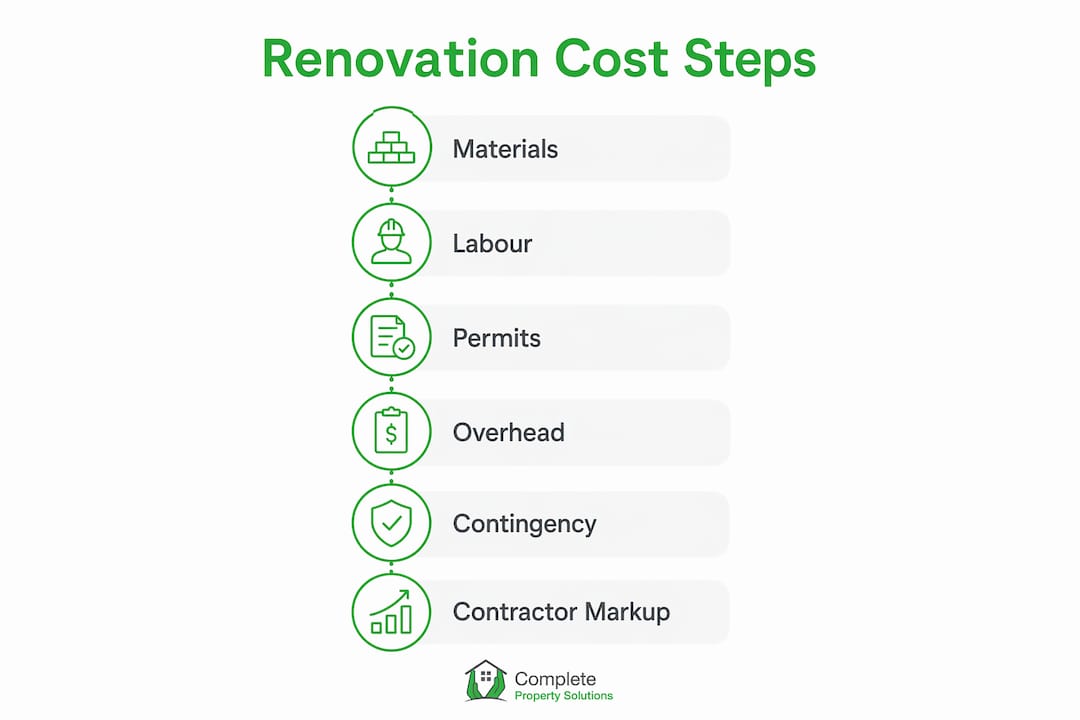
Renovation costs are the sum of materials, labour, permits, overhead, contingency reserves, and contractor markup applied to the total scope of a home improvement project. Understanding how renovation costs are calculated explained in plain terms means knowing that budgets typically range from £40,000 to £120,000 for major renovations, with materials accounting for 40–50%, labour 30–40%, permits and design 5–10%, and contingency 10–20%. These proportions are not rough guesses. They are industry benchmarks used by professional builders across the UK to price work accurately and protect both the homeowner and the contractor from financial surprises.
!
What factors influence renovation cost calculations?
Project scale is the single biggest driver of cost. A cosmetic refresh, such as new flooring and fresh paint, costs a fraction of a full structural remodel or gut renovation. Each project type carries a different risk profile, and that risk directly affects how much contingency a builder will build into the price.

Location matters considerably. Labour rates in the North West of England differ from those in London, and material delivery costs vary by region too. A builder working in Warrington or St Helens will price labour differently from one operating in central Manchester, even for identical scopes of work.
Room type is one of the most underestimated factors in calculating renovation costs. Wet rooms cost significantly more than dry rooms because they require waterproofing, plumbing, tiling, and specialist trades. A kitchen or bathroom extension carries far higher costs per square metre than a bedroom or living room of the same size.
- Project scale: Cosmetic, full remodel, and gut renovations each carry different cost structures and contingency requirements.
- Room type: Wet rooms (kitchens, bathrooms) cost more per square metre than dry rooms (bedrooms, lounges).
- Regional labour rates: Costs vary across the UK based on local trade availability and demand.
- Structural complexity: Removing load-bearing walls, adding steelwork, or altering drainage adds significant cost.
- Property age: Older homes frequently reveal hidden issues once work begins, increasing the likelihood of cost overruns.
Pro Tip: Never base your entire budget on a single per-square-metre rate. A figure of, say, £1,500 per square metre tells you very little without knowing how many wet rooms, structural changes, or specialist finishes are involved.
Every project is costed on an individual basis. Getting a full understanding of the end result means exploring different options before committing to a single approach.
How do professionals calculate renovation costs in practice?
Professional builders follow a structured process that goes well beyond a quick calculation. Understanding this process helps you read contractor bids with confidence and spot gaps before they become expensive problems.
Estimates, bids, and quotes: what is the difference?
These three terms are not interchangeable. An estimate is a rough ballpark figure; a bid or quote is a firm price for a defined scope of work. A detailed written bid should itemise costs by trade, list materials with quantities, and specify what is and is not included. If a contractor hands you a single lump sum with no breakdown, that is not a bid. It is a guess.
How the numbers are built
Professionals calculate renovation costs using the following components:
- Itemised materials: Every material is listed by quantity and unit cost, from structural timber to door handles.
- Labour by trade: Groundworkers, bricklayers, plasterers, electricians, and plumbers are each priced separately based on hours and day rates.
- Permits and design fees: Building regulations applications, architectural drawings, and structural engineer reports are included as line items.
- Indirect costs: Site supervision, equipment hire, skip hire, and disposal fees are costs that homeowners frequently overlook but that professionals must account for.
- Overhead allocation: Residential remodellers average 23.6% in operating expenses as overhead. This covers office costs, insurance, vehicles, and management time.
- Markup: Professionals apply roughly a 1.43x multiplier to the total cost of sales to reach the final client price, targeting a gross margin of around 29.9%.
Pro Tip: When comparing bids, check that every bid covers the same defined scope. A bid that looks £8,000 cheaper may simply exclude plastering, decoration, or building control fees.
Bid spreads of more than 50% between the highest and lowest quotes are a red flag. They signal that contractors have interpreted the scope differently, or that one is underbidding to win the work. Bids for the same scope should typically fall within a 20–30% range of each other.
Renovation cost breakdown: how is a budget allocated?
A well-structured renovation budget follows a clear allocation across five categories. Knowing these proportions helps you check whether a contractor’s quote is balanced or whether key costs have been left out.
| Budget category | Typical allocation | What it covers |
|---|---|---|
| Materials | 40–50% | Structural, finishing, fixtures, fittings |
| Labour | 30–40% | All trades from groundwork to decoration |
| Permits and design | 5–10% | Building regulations, drawings, inspections |
| Overhead | Variable | Builder’s running costs, insurance, management |
| Contingency | 10–20% | Unforeseen works, price increases, hidden defects |
Contingency is not a buffer for wishlist additions. Contingency reserves should be 15–20% for renovations in existing homes and 10–15% for new construction or additions. Older properties carry the higher risk because hidden defects, such as damp, outdated wiring, or inadequate foundations, are only discovered once work begins.
Soft costs are the category most commonly omitted from homeowner budgets. These include:
- Temporary accommodation if you need to move out during works
- Storage costs for furniture and belongings
- Architect and structural engineer fees
- Party wall surveyor fees where applicable
- Building control inspection fees
- Landscaping or driveway reinstatement after groundworks
Omitting indirect and soft costs leads to budget shortfalls that force homeowners to either borrow more or compromise on finishes. Including them from the start is not pessimism. It is good planning.
You can find a detailed renovation stages checklist that maps these cost categories to each phase of a project, which makes tracking spend far more manageable.
!
How can homeowners accurately estimate and manage renovation costs?
The most reliable approach to home improvement cost estimation combines room-by-room pricing, multiple contractor bids, and a properly funded contingency reserve. Each of these steps removes a different source of error from your budget.
Price by room, not by total floor area
Room-by-room pricing produces more accurate budgets than a flat square-footage rate because it accounts for the real complexity of each space. A 10-square-metre bathroom costs far more to renovate than a 10-square-metre bedroom. Pricing them at the same rate per square metre produces a figure that is wrong before you have even started.
Obtain at least three detailed bids
A budget is only reliable when it is based on actual contractor bids, not online calculators alone. Seek at least three written bids from reputable builders. Provide each contractor with the same detailed brief so that the bids cover identical scopes. This is the only way to make a fair comparison.
Before you build a home extension, understanding what should and should not appear in a contractor’s quote saves considerable time and money later.
Track estimates against actuals
Set up a simple spreadsheet with columns for each budget line, the estimated cost, the actual cost, and the variance. Update it weekly throughout the project. This gives you early warning of overspend and helps you make informed decisions about where to adjust.
- Column 1: Budget line (e.g. groundworks, brickwork, first fix electrics)
- Column 2: Estimated cost from the accepted bid
- Column 3: Actual invoiced cost
- Column 4: Variance (positive or negative)
Avoid the lowest-bid trap
The lowest bid often masks an incomplete scope. A contractor who wins on price but excludes plastering, decoration, or building control fees will present change orders once work is underway. Those additions frequently cost more than the saving made at tender stage. A thorough bid at a fair price is always preferable to a cheap bid that grows.
Pro Tip: Ask every contractor to confirm in writing what is excluded from their price, not just what is included. Exclusions reveal the gaps that will cost you money later.
!
Key takeaways
Renovation costs are calculated by combining materials, labour, permits, overhead, and contingency into a structured budget, with professionals applying a markup of approximately 1.43x to reach the final client price.
| Point | Details |
|---|---|
| Core cost components | Materials, labour, permits, overhead, and contingency make up every renovation budget. |
| Industry proportions | Materials take 40–50%, labour 30–40%, permits 5–10%, and contingency 10–20% of the total. |
| Contingency sizing | Reserve 15–20% for existing home renovations and 10–15% for new additions or construction. |
| Bid comparison | Obtain at least three bids covering identical scopes; spreads above 50% signal a problem. |
| Soft costs matter | Temporary accommodation, storage, and professional fees must be included from the start. |
Why I always tell homeowners to budget for what they cannot see
After more than 35 years working on home extensions and renovations across Warrington, St Helens, and the surrounding areas, the single most consistent mistake I see homeowners make is treating the contingency as optional. They look at a £90,000 budget, see the 15% contingency line sitting at £13,500, and quietly decide to reduce it to free up money for a better kitchen. Then the groundworkers find a drainage run that was not on any plan, and suddenly that saving is gone and more.
The second mistake is accepting a bid without reading the exclusions. A price that looks competitive on the front page can carry a long list of excluded items on page three. I have seen bids that exclude plastering, external rendering, and even building control fees. Each of those items adds thousands to the final cost.
What I find works well is treating the budget as a living document. You start with the best information available, you get proper bids, you fund the contingency fully, and then you update the numbers every week as the project progresses. A renovation budget is not a one-time calculation. It is an ongoing process that keeps you in control from groundbreak to completion.
The homeowners who finish their projects on budget are almost always the ones who did the preparation work properly at the start. They understood the cost breakdown, they challenged their bids, and they kept their contingency intact. That preparation is what separates a smooth project from a stressful one.
— Gareth
Planning your renovation with Complete-property
Complete-property has delivered home extensions, conservatories, and garage conversions across Warrington, St Helens, Wigan, and the surrounding areas for over 35 years. Every project is priced on an individual basis with a fixed-price guarantee, so you know exactly what you are committing to before work begins.

Whether you are considering a house extension or exploring how a project might add long-term value to your home, the team at Complete-property provides detailed, transparent quotes that cover every cost category discussed in this article. No hidden extras, no vague lump sums. Get in touch with Complete-property today for a personalised quote and take the first step towards a well-planned, properly budgeted renovation.
!
FAQ
What is included in a renovation cost calculation?
A renovation cost calculation includes materials, labour by trade, permits, design fees, overhead, and a contingency reserve. Professionals also apply a markup to the total cost of sales to reach the final client price.
How much contingency should I budget for a home renovation?
Contingency should be 15–20% for renovations in existing homes and 10–15% for new additions. These funds cover unforeseen works and must not be reallocated to finishes or fittings.
Why do renovation quotes vary so much between contractors?
Large variations in quotes, particularly spreads above 50%, indicate that contractors have interpreted the scope differently or that one bid is incomplete. Always ensure every contractor prices the same defined scope.
Is a square-footage rate reliable for estimating renovation costs?
Square-footage rates give a rough starting point but are not reliable on their own. Wet rooms such as kitchens and bathrooms cost significantly more per square metre than dry rooms, so room-by-room pricing produces a far more accurate budget.
What are soft costs in a renovation budget?
Soft costs are expenses outside direct construction, including architect fees, structural engineer reports, building control applications, temporary accommodation, and storage. Omitting them is one of the most common causes of budget shortfalls.


