

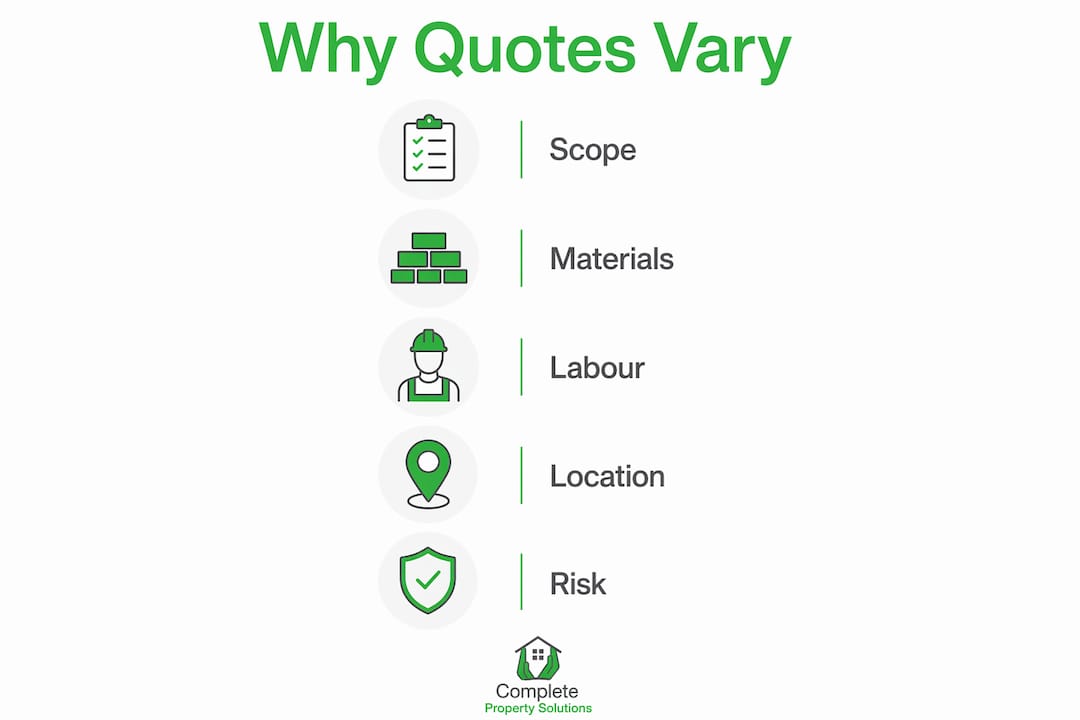
Extension quotes vary because builders price different scopes, materials, labour rates, and risk levels, often producing figures that look incomparable even for identical projects. The industry term for this is quote variation, and it is one of the most common sources of confusion for homeowners planning a home extension. The Federation of Master Builders reports average costs ranging from £1,800 to £3,000 per square metre, with location alone capable of pushing prices 30–50% above the national average in London and the South East. Understanding why extension quote differences exist is the first step to choosing the right builder with confidence.
!
Why do extension quotes vary so much?
Quote variation in extensions is defined as the measurable difference in price between two or more builders tendering for the same project. The gap is rarely about one builder being dishonest and another being fair. It reflects genuine differences in what each builder has included, how they have assessed risk, and what labour and materials they have priced.
The primary factors driving extension quote differences are:
- Project scope and specification: What exactly is included in the price
- Material quality: Standard versus premium finishes, glazing, and roofing
- Labour costs: Trade availability, skill level, and local wage rates
- Location: Regional price differences, particularly in the North West versus London
- Risk allocation: How builders account for ground conditions, delays, and price volatility
- VAT treatment: Whether quotes include or exclude VAT on labour and materials
Each of these factors can shift a quote by thousands of pounds. A homeowner comparing three quotes without understanding these drivers is comparing apples with oranges.
How do differences in project scope affect extension quotes?
Scope is the single biggest cause of quote discrepancies. Two builders can visit the same property, speak to the same homeowner, and return with quotes that differ by £15,000 or more, simply because they have priced different things.
Vague quotes hide exclusions that only surface once work begins. A cheap quote might omit foundations, structural engineer fees, building regulations inspections, internal plastering, or electrical first fix. These are not optional extras. They are core parts of any extension project, and their absence from a quote does not mean they will not be charged for later.
Applying quantity-surveying principles, such as a bill of quantities, gives every builder the same detailed list of works to price. This is the most reliable way to compare quotes on a like-for-like basis. Without it, each builder fills gaps in the brief with their own assumptions, and those assumptions drive the price apart.
Common items missing from low quotes include:
- Foundations and groundworks beyond standard depth
- Structural calculations and engineer sign-off
- Building regulations application and inspection fees
- Internal finishes such as plastering, skirting, and decoration
- Drainage alterations and soil pipe connections
- Temporary weatherproofing and site protection
Pro Tip: Always request a written, itemised breakdown from every builder you approach. Then ask each one to confirm in writing what is NOT included. The answers will tell you more than the headline price.
A good builder will ask you detailed questions before producing a quote. They will want to understand your ground conditions, your preferred finishes, your timeline, and your budget. If a builder produces a quote after a ten-minute site visit with no follow-up questions, treat that figure with caution.
Why do material choices cause such big price differences?
Material specification is the second most significant driver of quote fluctuation. Two extensions of identical footprint can differ by £20,000 or more based purely on the materials specified.

The cost difference between materials ranges from standard uPVC windows and a basic flat roof at the lower end, to aluminium bi-folding doors, a lantern roof, and premium insulated render at the upper end. Both are legitimate choices. The problem arises when builders quote different specifications without making that clear.
Key material choices that affect price include:
- Roofing: Flat felt roof versus a solid tiled roof or glazed lantern
- Glazing: Standard double-glazed uPVC versus aluminium-framed, thermally broken units
- Doors: French doors versus bi-folding or sliding doors
- External walls: Brick-and-block versus structural insulated panels or insulated render
- Flooring: Screed base only versus underfloor heating and finished floor covering
- Internal finishes: Plasterboard and skim versus premium boarding and coving
Higher-specification materials cost more upfront but typically deliver better thermal performance, lower running costs, and greater durability. A builder who specifies thermally efficient glazing and quality insulation is not overcharging. They are building something that will perform better for decades.
The advice here is straightforward. Before approaching builders, decide on your specification. Know whether you want uPVC or aluminium, a flat roof or a tiled one. That clarity removes one of the biggest variables from the quoting process.
!
What role do labour costs and location play in quote differences?
Labour is typically the largest single cost in any extension project, often accounting for 40–50% of the total quote. Labour costs vary by location, trade availability, project complexity, and the experience level of the tradespeople involved.
The BCIS construction industry forecast confirms that labour shortages and wage pressures continue to influence construction costs, with a forecast increase of 14–15% over five years. That pressure is not uniform across the country. In areas where skilled bricklayers, groundworkers, and specialist joiners are in short supply, builders pay more to secure them, and that cost passes through to the quote.
Regional price differences are significant. London and South East extension costs run 30–50% above the national average, according to the FMB. In the North West, including areas like Warrington, St Helens, and Wigan, prices are generally more competitive, though local demand still influences rates.
Factors that push labour costs higher include:
- Specialist trades such as structural steelwork, underfloor heating, or bespoke joinery
- Projects requiring multiple trade disciplines working in sequence
- Tight timelines that require additional workers or overtime
- Difficult access or confined sites that slow progress
- Builders with higher levels of experience, accreditation, or insurance
Pro Tip: The cheapest labour is rarely the best value. A highly experienced team working efficiently will often complete a project faster and with fewer costly errors than a cheaper crew. Ask builders about their trade qualifications and how long they have worked together as a team.
Understanding how home extension planning works before you approach builders helps you ask the right questions about trade requirements and programme length.
How do builders manage risk in their extension quotes?
Risk allocation is a less visible but powerful driver of quote variation. Every builder assesses the same project differently and prices their uncertainty accordingly.
Between 2022 and 2023, material price volatility caused builders to add supply risk premiums to quotes as protection against unpredictable cost increases. Checkatrade reported that the median cost of building jobs dropped from £8,000 in 2023 to £6,000 in 2025, attributed directly to eased material costs and the removal of those premiums. That shift explains why quotes today look different from those issued two or three years ago.
Builders also allocate risk for:
- Ground conditions that differ from what is visible at the surface
- Design changes requested by the homeowner during the build
- Delays caused by planning, building control, or material supply
- Structural discoveries such as inadequate existing foundations
- Weather-related programme extensions
A builder who has encountered difficult ground conditions on a previous project nearby will price more conservatively for groundworks. That is not padding. It is professional risk management.
VAT treatment also creates apparent quote discrepancies. VAT of 20% applies to both labour and materials, but some builders present quotes inclusive of VAT and others exclusive of it. A £50,000 quote excluding VAT and a £60,000 quote including VAT are the same price. Always confirm whether VAT is included before comparing totals.
“Contractors allocate risk differently for changing ground conditions, design finalisation, and supply challenges, influencing individual quotes significantly.” — Checkatrade, Home Improvement Index Q4 2025
How can homeowners compare extension quotes effectively?
Comparing quotes on total price alone is the most common mistake homeowners make. The right approach is to compare line by line, using the same scope of works as the reference point.
Building contract advisors recommend that any quote more than 15% cheaper than the others should prompt careful scrutiny. The gap almost always reflects something that has been excluded, not a builder who is simply more efficient.
Practical steps for effective quote comparison:
- Provide every builder with the same drawings, schedule of works, and material specification
- Ask each builder to confirm what their quote includes and excludes in writing
- Check whether VAT is included in every quote before comparing figures
- Ask how the builder handles unexpected ground conditions or structural discoveries
- Request a programme of works showing how long each phase will take
- Verify building regulations compliance and who is responsible for applications
Pro Tip: Use the extension price calculator from Complete-property to get a realistic cost range before approaching builders. It gives you a benchmark so you can spot quotes that are unusually high or low.
A transparent builder will welcome these questions. They will explain the reasoning behind their price, offer alternatives if your budget is tight, and flag risks they have identified on your site. If a builder cannot or will not answer these questions clearly, that tells you something important about how they will communicate during the build itself.
!
Key takeaways
Extension quote variation is caused by genuine differences in scope, materials, labour, location, and risk, not simply by builders pricing dishonestly.
| Point | Details |
|---|---|
| Scope drives the biggest gaps | Always request an itemised breakdown and ask what is excluded, not just what is included. |
| Materials must be specified upfront | Decide on glazing, roofing, and finishes before approaching builders to enable like-for-like comparison. |
| Labour and location matter | Regional wage rates and trade availability can shift quotes significantly, even for identical projects. |
| Check VAT before comparing | A quote excluding VAT can appear 20% cheaper than one that includes it, with no actual price difference. |
| Question quotes 15% below the rest | A significantly lower quote almost always reflects exclusions rather than genuine efficiency. |
My honest view on extension quotes after 35 years
I have seen homeowners choose the cheapest quote and end up paying far more than the highest quote they originally rejected. The extra costs come later, in the form of variations, unexpected groundwork charges, and finishes that were never included in the first place.
The builders I respect most are the ones who take time at the very beginning. They ask questions. They want to understand what you are trying to achieve, not just how many square metres you want to add. They explain the upsides and downsides of your choices. They offer alternatives when something is outside your budget. They flag risks before work starts, not after.
A detailed, transparent quote costs a builder more time to produce. That time investment is a signal. It tells you the builder is serious, organised, and planning to deliver what they have promised. A one-page quote with a single total figure is a warning, not a bargain.
The market has also changed. With material costs stabilising since 2025, the supply risk premiums that inflated quotes in 2022 and 2023 have largely disappeared. Homeowners are in a better position now than they were two years ago. Use that position wisely. Get three detailed quotes, compare them properly, and choose the builder who communicates best, not just the one who charges least.
— Gareth
Transparent extension quotes from Complete-property
!
Complete-property has been helping homeowners across Warrington, St Helens, Wigan, and the surrounding areas plan and build quality home extensions for over 35 years. Every quote we provide is fully itemised, VAT-inclusive, and fixed-price, so you know exactly what you are getting before work begins. We take the time to understand your project properly, explain your options honestly, and flag anything that could affect your budget or timeline. If you want to understand what your extension should realistically cost, or if you have received quotes that do not add up, get in touch with our team for a straightforward conversation. We are happy to help you make sense of what you have been quoted and give you a clear, comparable figure to work from.
FAQ
Why are two extension quotes for the same project so different?
Builders price different scopes, materials, and risk levels, even when visiting the same property. Without a detailed schedule of works, each builder fills gaps with their own assumptions, which drives prices apart.
Does a cheaper extension quote mean lower quality?
Not always, but a quote more than 15% below others almost always reflects missing items rather than genuine efficiency. Always ask what the quote excludes before accepting a lower price.
Is VAT included in extension quotes?
Not always. Some builders quote excluding VAT, which adds 20% to the final cost. Always confirm whether VAT is included before comparing quotes side by side.
How do I get comparable extension quotes?
Provide every builder with the same drawings, material specification, and schedule of works. Ask each one to confirm inclusions and exclusions in writing. This is the only reliable way to compare figures fairly.
Why have extension quotes dropped since 2023?
Material costs stabilised after the volatility of 2022 and 2023, and builders removed the supply risk premiums they had added to protect against price increases. Checkatrade reported the median cost of building jobs fell from £8,000 in 2023 to £6,000 in 2025 as a result.


