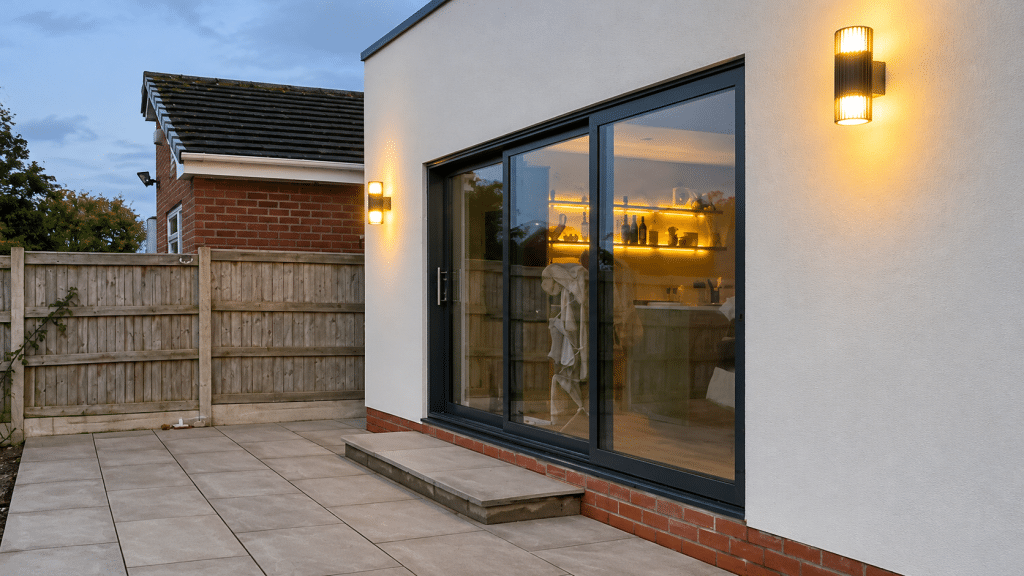
A fixed price extension quote gives you an agreed sum for a clearly defined set of works. That means a builder who has priced the job properly carries the risk of materials and labour getting dearer while they build. It does not mean the price can never move. Changes you ask for, genuinely unforeseen work and anything listed as an exclusion can still alter the total, which is why the detail in the quote matters as much as the figure on the front.
We are a family-run building company with more than 35 years of experience, and we price extensions for homeowners across Warrington, St Helens, Wigan and the surrounding villages. This guide explains how a fixed price protects your extension budget, how a quote differs from an estimate, and what to check before you sign.
Complete-Property-Solutions
Plan Your Extension Budget Clearly
Complete Property Solutions manages extensions from design through completion and provides transparent fixed-price quotations for homeowners across the local area.
In plain terms, a fixed price quote is an offer to carry out one described piece of work for one stated sum. Citizens Advice explains that a quote is a promise to do the work at an agreed price, and once you accept it, it is binding. The trader can charge more only for extra work you ask for, extra work you agree is needed, or a genuine mistake in the pricing. You can read the details on the Citizens Advice page on getting building work done.
The important phrase is “defined scope”. The price is fixed against the work described on paper, not against the vague idea of “the extension”. A two-line quote that says “single-storey extension, one price” protects you far less than a multi-page document that sets out the foundations, structure, roof, windows, electrics, plastering and finishes.
If no price was agreed at all, the law generally falls back on a reasonable price, which is a question of fact in each case, and that is a much weaker place to start from when you are managing a budget.
Quote or estimate: why the word matters
People use the two words interchangeably, but they are not the same thing, and the difference matters when you are comparing builders across Warrington, St Helens and Wigan.
Trading standards guidance for homeowners describes a quotation as an exact price that cannot be increased without your agreement, while an estimate is a rough price that may change. The same guidance suggests checking whether VAT is included. You can see this in the trading standards tips for employing a builder.
In practice:
Estimate
Fixed price quote
Purpose
A rough guide to likely cost
A price you can accept and rely on
Can it change?
Yes, as the job becomes clearer
Only for agreed changes, unforeseen work or stated exclusions
Detail
Often brief
Should list scope, materials, allowances and exclusions
Best used for
Early budgeting
Signing a contract
An estimate is a perfectly sensible starting point when you are still deciding between a side extension and a wraparound, for example. The trouble starts when an estimate is treated as a promise. Always ask in writing which one you are being given. If it is an estimate, ask what would turn it into a fixed price.
How a fixed price shields you from rising labour and material costs
Building costs move during a project. Bricks, steel, insulation, glazing and timber can all rise between the day you sign and the day the roof goes on, and trades can raise their day rates.
The Joint Contracts Tribunal (JCT), whose contracts are widely used in UK construction, set out the position in its guidance of 14 October 2022: where a contract has no fluctuation clause, the risk of inflation lies with the contractor, and cost increases caused by inflation are unlikely to change the contract sum. Its guidance on managing inflation risk also explains the alternative: optional fluctuation provisions that adjust the price for changes in labour, material or fuel costs, in either direction.
Lawyers writing on the subject note that most UK construction contracts are lump sum or fixed price, with the contractor bearing the risk of changes in expenditure, and that a fluctuation provision is what allows the price to be adjusted for material and labour costs during the contract period. That is set out in this Lexology briefing on drafting for price inflation.
What this means for you:
Ask whether the contract has a fluctuation clause. If it does, your price can rise or fall with costs. If it does not, the price is fixed against inflation for the agreed scope.
Look at the timing. A price is only as safe as the programme behind it. The JCT notes that a contractor cannot use fluctuation provisions to recover increases for periods after the completion date where the contractor is responsible for the delay.
Keep your own changes to a minimum. A late switch of kitchen layout or glazing can mean re-ordering at today’s prices rather than the ones that were allowed for.
Materials pricing is a topic in its own right. If you want to see how the choice of material shapes cost and lifespan on a roof, this piece on roofing materials and costs shows the same logic at work, although the figures there relate to a different market.
What can still change the total
A fixed price is not a blank cheque for you or for the builder. Three things can legitimately move the figure, and a good contract names them up front.
Changes you ask for
If you move a wall, upgrade the bi-folding doors or add underfloor heating after signing, that is a variation. DLA Piper’s guidance for England and Wales explains that employer-instructed variations generally entitle the contractor to extra time and money, whereas variations needed because of the contractor’s own error or default generally do not. See DLA Piper’s overview of fixed price contracts.
In plain English: if we get something wrong, that is on us. If you change your mind, the change is priced and agreed first.
Unforeseen work
Ground and hidden conditions are the classic example. Legal commentary on ground risk notes that where a fixed price contract is silent, the usual position places the risk of more difficult or expensive site conditions on the contractor, but the parties can allocate that risk expressly. You can read more in Fenwick Elliott’s analysis of ground risk.
In a domestic extension, that is why the quote should state its assumptions, such as the foundation depth allowed for, and say what happens if the ground or an existing structure turns out to be different. Hidden drains, unmarked services, or an old wall that is not built as it appeared are the usual surprises on older homes in Wigan and St Helens. We tell you how any such work will be priced before it is done, not after.
Stated exclusions
Every quote leaves something out. The point is that it says so. Typical exclusions include planning and building control fees, structural engineer’s drawings, kitchen units and appliances, decoration, landscaping and the removal of asbestos if it is found. Building quote exclusions are not a trick, but a vague list is a warning sign.
All of this is subject to the terms of your contract, so read it carefully and ask us to explain anything that is unclear.
What a detailed quote should contain
The strength of your extension budget depends on how much is written down. Here is what we suggest you look for in any quote, ours included.
A detailed scope of work
The scope should describe the project room by room and stage by stage: groundworks and foundations, brickwork and structure, roof, windows and doors, insulation, first-fix and second-fix electrics and plumbing, plastering, and finishing. Drawings and a specification should be attached or referenced. If the quote says “to be agreed” in several places, those are the places where the price can move.
Clear allowances
Some items cannot be priced exactly at signing because you have not chosen them yet, such as tiles, sanitaryware or kitchen units. These are usually covered by provisional sums or prime cost allowances. Legal commentators warn that provisional sums should be drafted with great precision, because the contractor can usually amend them and they can push the final price up. See the Lexology briefing for the legal background.
Your protection is to ask for each allowance as a separate line, with a clear figure, and to choose those items early. Where you can, choose before signing so they move from allowance to fixed.
Staged payments
Payments tied to completed stages keep money and progress in step. A typical pattern is a modest deposit, then payments at milestones such as foundations complete, structure watertight, first fix complete and final completion. Avoid paying large sums upfront for work that has not started. Staged payments also give you natural points to check progress against the scope.
Written agreement of extras
Before any extra work starts, you should receive a written description, a price and any effect on the programme, and you should sign it off. This one habit prevents most disputes. If you are not sure whether something is an extra, ask before the work happens.
Insurance-backed protection
Citizens Advice recommends checking whether your contract includes an insurance-backed guarantee, which protects the project if the builder becomes insolvent after the work is complete. Ask any builder what cover is offered and get it in writing.
A proper contract
For small domestic projects such as extensions and alterations, the JCT publishes a Building Contract for a Home Owner/Occupier designed for an agreed lump sum. Whichever form of contract is used, make sure it is written, signed and clear on price, scope, timing, payment and variations.
House extension costs in Warrington, St Helens and Wigan: what moves your budget
We do not quote a headline price per square metre here, because a figure without a scope is exactly the kind of number that misleads. What we can say is what shapes house extension costs across Warrington, Great Sankey, Penketh, Culcheth, Lowton, Rainhill, Haydock and Wigan.
Size and type. A single-storey rear extension, a wraparound and a two-storey extension have very different structures and roofs.
Regulations. Building Regulations approval applies to almost every extension, and some projects need planning permission. Our page on permitted development, planning permission and building regulations covers the basics, and your local council confirms the specifics for your address.
For worked examples and a way to test your own figures, use our extension cost guide. If you are comparing several prices and they are far apart, why extension quotes vary so much will help you work out whether you are comparing like with like.
When a fixed price runs out
A quote is normally valid for a stated period. Once that date passes, the price may be reviewed against current labour and material rates. That is not unreasonable, because the builder’s own supplier prices will have moved, but it means a quote is not something to leave in a drawer for a year.
Two practical points. First, check the validity period on any quote and note it. Second, if you are still waiting on planning or building control approval, ask how that affects the price and start date. We are happy to talk through this with you at the outset, and our guide to avoiding hidden costs in fixed price building contracts goes through the typical sticking points.
Our perspective
After more than 35 years of building extensions, we have learned that the biggest budget problems rarely come from the price on the front page. They come from what was left vague: an allowance that was too low, an exclusion nobody noticed, or an extra agreed over a cup of tea and never written down.
That is why we put so much effort into the scope. We design and manage your project from the first drawing through to completion, so the person who prices the job is close to the person who builds it. We would much rather spend an extra hour at a site visit in Warrington or Rainhill than discover a problem halfway through.
We describe our quotes as transparent and fixed price for a defined scope, and we explain anything that could change the total, such as your own changes, unforeseen work or exclusions, before you sign. Everything is subject to the contract, and we want you to read it.
Our advice is simple: ask every builder the same questions, compare the detail not just the total, and choose the team you trust to tell you the truth when something unexpected turns up.
Gareth
Arrange a site visit
If you are planning a house extension, kitchen extension, wraparound or garage conversion in Warrington, St Helens, Wigan or nearby, we would be glad to look at your property and talk it through. We are a Guild of Master Craftsmen member and an approved HUP! Building System partner, and we manage the whole job from design to completion.
To see what we build, visit our house extensions page or get in touch to arrange a site visit, and we will talk you through a written quote with the scope, allowances and exclusions laid out clearly.
FAQ
Is a fixed price extension quote the same as a guarantee that the price will never change?
No. A fixed price quote is an agreed sum for a defined scope of work. It can still change if you request extra work, if unforeseen work is agreed as necessary, or if something was listed as an exclusion. Read the contract terms and ask for every change in writing.
Can a builder put the price up because materials have gone up?
Under Citizens Advice guidance, a trader cannot charge more than the quoted price unless you ask for extra work, agree to extra work they say is needed, or they made a genuine pricing mistake. If your contract includes a fluctuation clause, the price may be adjusted, so check for one before you sign.
What should I look for in building quote exclusions?
Look for a clear list of what is not included, such as fees, engineer’s drawings, kitchen units, decoration and landscaping. Ask what happens if hidden problems such as asbestos or poor ground are found, and how any extra work will be priced and approved.
How do I budget for an extension in Warrington, St Helens or Wigan?
Start with your must-haves, ask for a detailed written quote based on drawings, and keep a contingency for the unexpected. Our guide to getting accurate fixed price quotes shows how to prepare. A site visit is the best way to get a firm figure for your property.
How long is a quote valid?
That depends on the quote, and it should be stated on the document. Once the validity period ends, the builder may re-price based on current labour and material costs, so ask for the expiry date and plan your decision around it.