

Home extension planning is the organised process of moving from an initial idea to a compliant, construction-ready project. Understanding how this process works gives you control over your budget, your timeline, and the quality of the finished space. The steps for home extension projects cover everything from defining your lifestyle needs and checking permitted development rights to securing building regulations approval and selecting a trustworthy builder. Get this process right from the start and you avoid the costly surprises that derail so many projects across Warrington, Wigan, and the wider North West.
What are the essential initial steps when planning a home extension?
The single most important step in any home extension planning guide is defining the problem your extension needs to solve before you speak to an architect or request a single quote. Most homeowners start designing too early, commissioning drawings before they have clarity on how the space will actually be used. This leads to expensive mid-project revisions and wasted design fees.
Start with a clear brief that answers these questions:
- What daily frustration or lifestyle need is driving this project? A growing family needing a larger kitchen is a very different brief to a home worker needing a dedicated office.
- How many square metres do you genuinely need, and how will the new space connect to the existing house?
- What is your realistic budget, including VAT and a contingency reserve?
- Do you have any site constraints such as a sloped garden, shared boundaries, or a listed building designation?
On budget, UK extension costs range from £40,000 to over £150,000 depending on size and complexity. That is a wide range, and it reflects how dramatically specification choices affect the final figure. A 10-15% contingency fund is recommended to cover unexpected site-specific expenses, and this should be treated as a fixed line in your budget from day one, not an afterthought.
Pro Tip: Before you approach any designer, spend an hour writing down exactly how you will use the new space on a typical Tuesday morning. This single exercise produces a better brief than most homeowners give their architects, and it prevents you paying for a design that looks beautiful but does not fit your life.
Once your brief is clear, use the government’s Planning Portal to check your permitted development rights. This tells you whether your proposed extension falls within the rules that allow work without full planning permission. Checking this early shapes your design parameters and your timeline.

How does the planning permission and building regulations process work?
Planning permission and building regulations are two separate legal requirements, and confusing them is one of the most common home extension mistakes homeowners make. Planning permission controls whether you can build at all. Building regulations control how you build, covering structural safety, fire protection, thermal performance, and electrical work.
Here is how the process typically unfolds:
- Check permitted development (PD) rights. Many single-storey rear extensions fall within PD rules, meaning you do not need a formal planning application. However, PD rights do not apply to flats, listed buildings, or properties in designated areas such as conservation zones.
- Apply for a Lawful Development Certificate (LDC) if using PD. This is not legally required, but it provides written confirmation from your local authority that the work is lawful. It protects your position when you come to sell the property.
- Submit a full planning application if required. The statutory planning decision period averages 8 weeks, but a safer allowance is 13 weeks to accommodate delays or amendments. Factor this into your overall project timeline.
- Submit a building regulations application. This is separate from planning and covers technical compliance. You will need to submit drawings and specifications to your local authority building control or an approved inspector.
- Arrange staged inspections. A building control officer will visit at key stages: foundations, damp proof course, structural frame, insulation, and final completion. The relevant documents are Part A (structure), Part B (fire safety), Part L (energy efficiency), and Part P (electrical safety).
“Permitted development rights are frequently misunderstood. Even when PD applies and no planning application is needed, full building regulations compliance remains mandatory. Skipping building control sign-off creates serious problems when you sell your home.” — Planning Design
The home extension permits process is not something to rush. Allocate proper time for each stage and keep copies of every approval document you receive.
How are designs and technical details developed before construction?
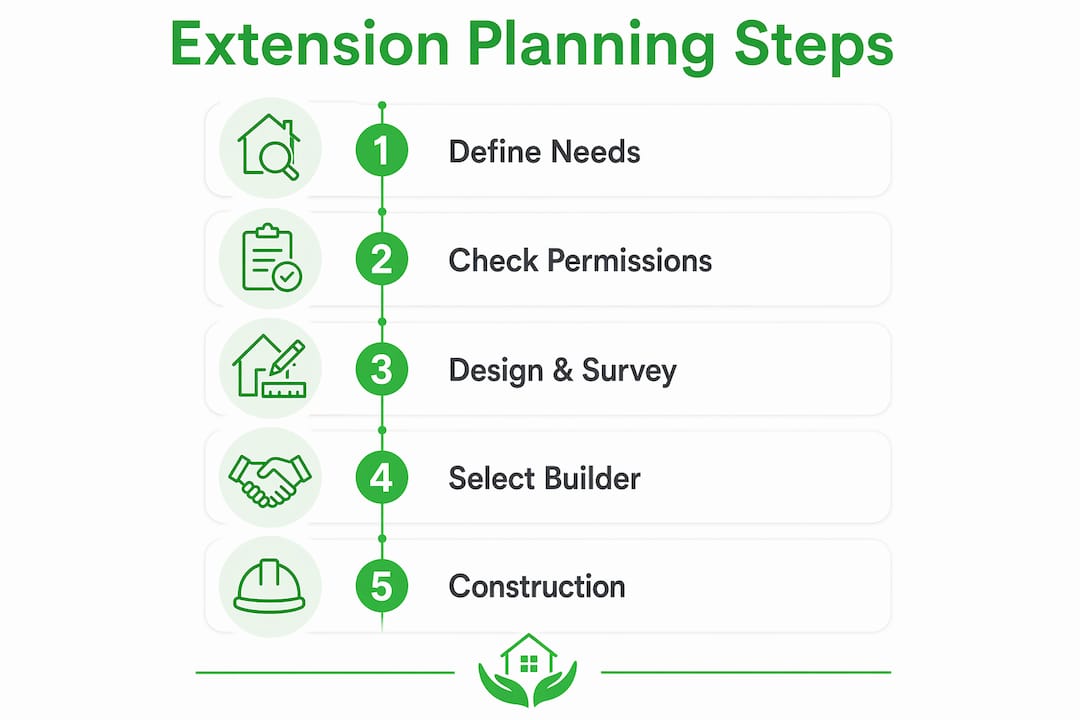
Once your planning position is confirmed, the design development phase begins. This is where your brief is translated into detailed drawings and specifications that builders can price accurately and build from. Vague drawings produce vague quotes, and vague quotes produce costly variations once work is underway.
A complete design package for a home extension should include:
- Floor plans, elevations, and sections drawn to scale
- Window and door specifications, including frame material, glazing type, and thermal performance ratings
- Insulation specification for walls, roof, and floor to meet Part L requirements
- Heating and ventilation strategy, particularly if you are adding underfloor heating or extending an existing system
- External finishes: brick type, roof tile, render colour, and any bespoke features such as bi-folding doors or an orangery-style lantern roof
Structural engineer input is not optional on most extensions. The engineer calculates beam sizes, foundation depths, and load paths, and their calculations form part of your building regulations submission. Skipping this step or using under-specified calculations is a false economy that can result in failed inspections and costly remedial work.
Surveys are equally important before finalising your design. A party wall surveyor is needed if your extension is within 3 metres of a neighbouring property’s foundations. A soil investigation may be required on sites with clay-heavy ground or near trees. Drainage checks confirm whether existing runs need diverting.
Pro Tip: When tendering the project to builders, send the same complete drawing package to each one and ask for a fully itemised quote. This is the only way to compare like for like. A quote that simply states a lump sum tells you very little about what is and is not included.
| Design element | Why it matters |
|---|---|
| Structural engineer calculations | Required for building regulations; prevents costly inspection failures |
| Full window and door specification | Avoids substitution disputes and ensures thermal compliance |
| Party wall agreement | Legally required in many cases; delays project if left too late |
| Drainage survey | Identifies conflicts before groundworks begin |
| Itemised tender package | Produces comparable quotes and reduces variation risk |
What are the key considerations when selecting builders and preparing for construction?
Choosing the right builder is where many otherwise well-planned projects go wrong. Selecting a builder based on the lowest price alone frequently leads to poor quality finishes, missed deadlines, and formal disputes. The right question is not “who is cheapest?” but “who delivers the best value with the least risk?”
When vetting contractors, look for:
- A portfolio of completed extensions with references you can actually call
- Public liability insurance and employers’ liability insurance, both current and confirmed in writing
- Membership of a recognised trade body such as the Guild of Master Craftsmen or the Federation of Master Builders
- A clear and detailed written contract covering scope of works, payment milestones, start and completion dates, and a dispute resolution process
- Transparent communication about subcontractors, particularly for groundworks, electrical, and plumbing trades
On insurance, failing to inform your home insurer before construction starts can leave significant gaps in your coverage during the build. Contact your insurer before work begins and confirm in writing that your policy covers the construction phase.
Site logistics matter more than most homeowners anticipate. Think through access for delivery vehicles, skip placement, temporary hoarding to protect your garden, and how utilities such as gas and electricity will be managed if they need temporary disconnection. Order long-lead items, particularly windows and bi-folding doors, well in advance. Bespoke glazing units can take 8 to 12 weeks to manufacture and deliver.
Pro Tip: Speak to your neighbours before work starts and give them a realistic timeline. If your extension triggers the Party Wall Act, serve notice at least two months before your planned start date. Neighbours who feel informed are far less likely to raise formal objections that delay your project.
A well-planned single-storey extension typically takes 6 to 12 months from decision to completion, with 5 to 7 months devoted to pre-construction activities. That pre-construction phase is where the quality of your finished project is largely determined.
Key takeaways
Successful home extension planning requires a clear brief, confirmed permissions, detailed technical drawings, and a vetted builder before a single spade enters the ground.
| Point | Details |
|---|---|
| Define needs before designing | Write a detailed brief before approaching architects to prevent costly revisions. |
| Budget with contingency | Set aside 10-15% above your build cost to cover unforeseen site issues. |
| Separate planning from building regs | Both approvals are required; permitted development does not remove building regulations obligations. |
| Complete design before tendering | Full drawing packages produce comparable, accurate quotes and reduce variation risk. |
| Vet builders beyond price | Check insurance, references, and contracts before committing to any contractor. |
What I have learned from 35 years of extension projects
After more than three decades working on home extensions across Warrington, St Helens, and the surrounding areas, the pattern I see most often is this: homeowners underestimate how much of the project happens before anyone arrives on site. They expect the planning phase to take a few weeks and are genuinely surprised when it takes five or six months. That is not a failure. That is the process working correctly.
The projects that go smoothly share one characteristic: the homeowner made decisions early and stuck to them. Changing your mind about the kitchen layout after the structural steel is ordered costs real money and real time. The homeowners who treat the design phase as the most important phase, not the construction phase, consistently get better results.
I also think the industry does a poor job of explaining the difference between planning permission and building regulations to people who have never built before. They are not the same thing, they are not handled by the same people, and getting one does not mean you have the other. If there is one thing worth spending time on in this guide, it is that distinction.
Living through a build is genuinely disruptive, and I would encourage you to plan for that honestly rather than optimistically. Seal off work areas properly, arrange temporary kitchen or bathroom facilities if needed, and accept that there will be dusty days and noisy mornings. The result is worth it. But going in with realistic expectations makes the process far less stressful than going in with the assumption it will all be tidy and quiet.
— Gareth
How Complete-property can take your extension from idea to completion
Complete-property has been helping homeowners across Warrington, St Helens, Wigan, Southport, and the wider North West turn extension ideas into finished, compliant spaces for over 35 years. The team manages the entire process, from helping you shape your initial brief and understanding planning permission through to coordinating building regulations, structural engineers, and on-site construction. Every project comes with a fixed-price guarantee, so the budget you agree at the start is the budget you pay at the end. If you are ready to explore what is possible for your home, take a look at the full range of home extension services or get in touch with the team directly for a friendly, no-obligation conversation.
FAQ
Do I always need planning permission for a home extension?
Not always. Many single-storey rear extensions fall within permitted development rights and do not require a formal planning application. However, building regulations approval is always required regardless of whether planning permission is needed.
How long does home extension planning take in the UK?
A typical single-storey extension takes 6 to 12 months from initial decision to completion, with the pre-construction phase alone accounting for 5 to 7 months. Planning decisions average 8 weeks, though a 13-week buffer is advisable to allow for amendments.
What is the difference between planning permission and building regulations?
Planning permission determines whether you are allowed to build the extension at all. Building regulations govern how it must be built, covering structure, fire safety, insulation, and electrical work. Both are separate approvals handled by different departments.
How much should I budget for a home extension?
UK home extension costs typically range from £40,000 to over £150,000 depending on size and specification. Always include a 10-15% contingency on top of your build cost to cover unforeseen ground conditions or site-specific issues.
What are the most common home extension planning mistakes?
The most frequent mistakes are starting the design before defining a clear brief, confusing permitted development with building regulations compliance, and choosing a builder on price alone without a formal written contract. Each of these errors adds cost and time to the project.


